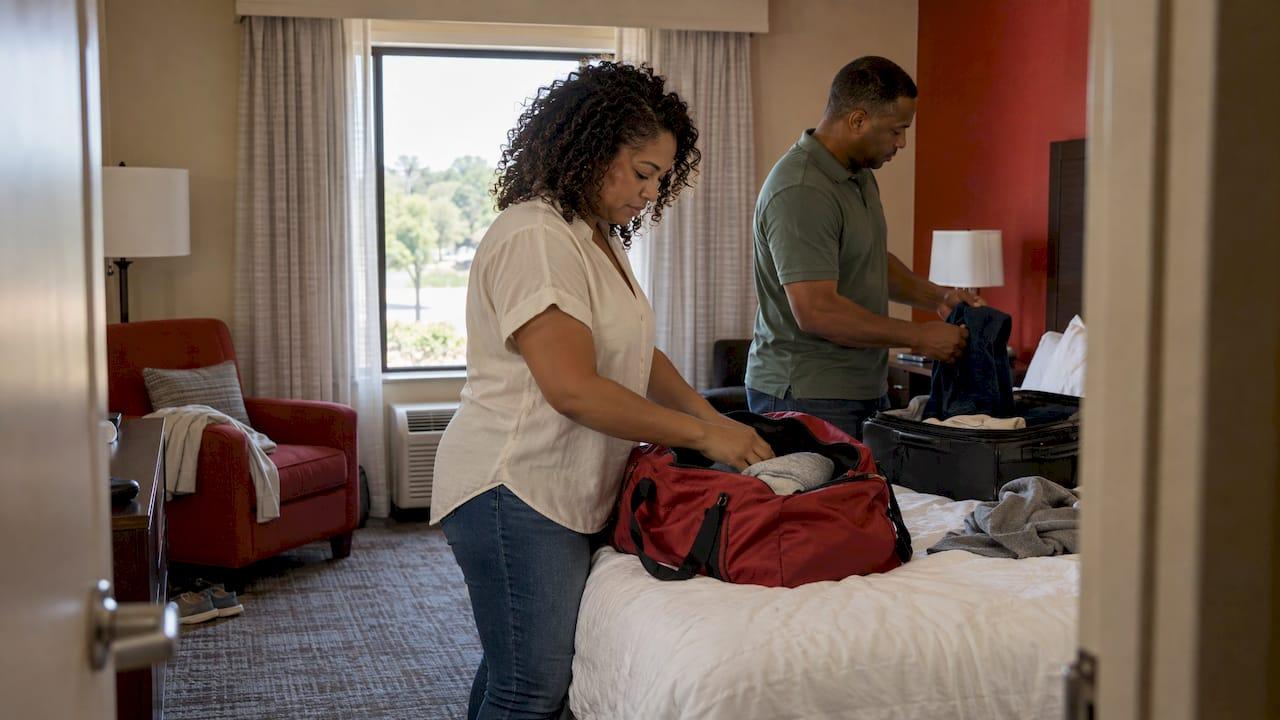
Additional Living Expenses: What Your Policy Pays

Additional living expenses (ALE) are the part of your homeowners policy that pays the extra cost of living somewhere else while a covered loss makes your house unlivable. It is usually listed as Coverage D, or “loss of use,” and it covers the added costs of temporary housing while repairs are under way. The part most homeowners miss: ALE has a dollar cap and a time cap, and the clock runs while the house is being fixed. The faster the water, mold or fire damage is dried, cleaned and rebuilt, and the better it is documented, the more of that coverage you have left. That is why we run cleanup, rebuild and claim under one roof at Ready 2 Inspect.
TL;DR
- ALE pays the difference between what you normally spend and what you spend while displaced. Your mortgage, normal utilities and luxury upgrades are not part of it.
- It applies only when a covered event makes the home unfit to live in. Limits are commonly a percentage of your dwelling coverage and a time limit, often 12 to 24 months.
- You usually pay first and get reimbursed, so pre-approve big expenses and keep every receipt.
- Repair time eats your ALE. A short, well-documented repair schedule protects it.
- Check your declarations page now, before you need it.
Table of Contents
- What ALE actually covers
- When ALE applies, and when it does not
- Dollar limits and time limits
- How reimbursement works
- Why repair speed decides how far ALE goes
- If the claim is slow or denied
- Water damage first, then the ALE question
- Our position on ALE
- Getting your home back, and the claim handled
- FAQ
- Sources
What ALE actually covers
The National Association of Insurance Commissioners (NAIC) explains that ALE pays only the difference between your normal living expenses and your new temporary ones. The policy may pay for a hotel or rental, but you still owe the mortgage.
Typical covered items, according to the Washington Insurance Commissioner:
- Temporary housing
- Meals above your usual food costs when you have no kitchen
- Storage and moving costs
- Laundry and dry cleaning
- Pet boarding
- Extra transportation to get the family to work and school
The same agency lists what is not covered: your normal mortgage or rent, normal utilities at the damaged home, luxury lodging (temporary housing should be comparable to your normal housing), and unrelated shopping or entertainment.
Oregon’s insurance regulator adds phone and internet fees to its list of covered items. American Family gives concrete examples: a hotel stay after a kitchen fire, mileage for a commute that is 4 miles longer, and a $10 daily hotel parking fee.
A worked example
Say your family spends $600 a month on groceries. In a hotel without a kitchen, you spend $1,300 a month eating out. Experian’s illustration of the math is that ALE pays the $700 difference, not the full $1,300. Keep that logic in mind for every line item: the question is always what you spend above normal.
When ALE applies, and when it does not
ALE follows the same rule as the rest of your policy: the cause of the loss has to be covered. The Texas Department of Insurance says policies pay ALE only when the home cannot be lived in because a covered event damaged it. A tornado-damaged house qualifies. Leaving because the power went out, with no damage, does not.
A few points that matter in Florida:
- Flood is a separate policy. Federal flood insurance policies do not provide ALE, according to the Florida Office of Insurance Regulation. A burst supply line, a failed water heater or a dishwasher leak is a different kind of loss than rising floodwater, so how your claim is classified matters.
- The home does not always have to be damaged. California’s insurance department notes that a policyholder can be eligible if the home is unsafe or uninhabitable because of a covered peril, such as loss of water, sewer or electric service. Your own policy wording decides this.
- Civil authority. Florida’s toolkit notes most policies also provide ALE when officials restrict access to your home because neighboring homes suffered covered damage.
- Florida policies generally carry no ALE deductible, per the same toolkit. Policies differ, so confirm yours.
Is mold or water damage a covered loss?
That depends on your policy’s wording and on the cause. Sudden events such as a burst pipe are treated differently from long-term seepage, and mold coverage is often limited. We cannot read your policy for you from here, so the answer lives in your declarations page and the language of the claim decision. What we can do is lay out every outcome before work starts, including the one where insurance pays nothing. More on that below.
Dollar limits and time limits
This is where homeowners get surprised. The Washington Insurance Commissioner says ALE is usually capped at 20% to 30% of dwelling coverage, so a 20% cap on $100,000 of dwelling coverage is $20,000. It also usually has a 12 to 24 month time limit. Texas reports most home, renters and condo policies pay 10% to 20% of the insured value, usually for up to 12 months, with the limit listed on the declarations page. If you hit the limit before repairs are finished, you pay the rest.
The NAIC points out that these ALE limits are separate from the coverage to rebuild the home and replace belongings. Spending on a hotel does not reduce your dwelling coverage, and vice versa.
To check your own numbers:
- Find the Coverage D or loss of use line on your declarations page.
- Note whether it is a dollar amount, a percentage, a time limit, or a combination.
- Compare it with real rents near you for a comparable home. The Washington regulator recommends that check, and a yearly policy review.
- If the limit looks low, talk to your agent before a loss, not after.
States also set their own rules. California, for example, gives wildfire victims at least 24 months with extensions. Do not assume another state’s protections apply to a Florida policy.
How reimbursement works
ALE pays for expenses you have already incurred. Travelers explains the routine:
- You pay the expense first.
- You pre-approve it with the claim professional, except in an emergency.
- You keep receipts in date order with a note on each.
- The claim professional works out what is owed and issues payment.
The Florida toolkit adds that the policy limit does not oblige the insurer to pay the amount up front or in full. If a security deposit and first month’s rent would strain you, the Washington Commissioner suggests asking for an advance in writing, with a specific itemized amount, then reconciling it against receipts later.
Expenses people forget
The nonprofit United Policyholders asks one test: was this an expense I incurred because of the loss? Its examples of reimbursed items include credit-check fees on a temporary rental, utility setup fees, and moving costs back into the repaired home. Travelers notes pet kennel fees count only if your temporary lodging does not allow pets, and that vet bills and grooming do not.
Keep a paper trail
The Florida toolkit tells claimants to file promptly, make reasonable emergency repairs, take photos, keep a phone log of every claim contact, and keep copies of anything signed. A roofer’s walk-through of how to handle repair estimates and records, such as these storm damage roof repair steps, shows the same habit: dated photos, written estimates and receipts support every line of a claim.

Why repair speed decides how far ALE goes
Travelers reimburses ALE for the “period of restoration,” the time reasonably required to make the home habitable. Your insurer is paying for that period, and you are living it. Every week a wet wall sits undried, every week the job waits for a second contractor, is a week of hotel and meals counted against a capped benefit.
Three things stretch the period of restoration:
- Water that is not dried in time. Wet drywall and insulation can become a mold job. Our guides on the first 24 to 48 hours after a burst pipe and on flood cuts explain what to do while you wait for help.
- Handoffs. One company tears out and another rebuilds, and each has its own schedule. The gap between them is often the longest stretch of the displacement.
- Unclear payment. Work stalls while everyone argues over who pays for what.
And there are two separate clocks you should know about. Some delays are outside anyone’s control, like permits or utility restoration. Others are claim-process delays. One property-insurance law firm advises claimants to build a timeline that separates the two, logging when estimates went in, what was requested and when you responded. A dated record of the repair schedule is the best evidence you can hand an adjuster.
If the claim is slow or denied
Start with your policy and the written decision. Ask the insurer to state in writing the reasons for any denial or partial payment. Keep your phone log current. Your state insurance department takes consumer complaints, and the NAIC tells policyholders to ask their agent, company or adjuster what time or dollar limits apply. The Florida toolkit also reminds you that the insurer has the right to inspect damage before it pays, so do not throw away damaged materials until it has had the chance.
One caution from Oregon’s insurance regulator: claims close to your deductible may not produce meaningful payment, and claims in the last five years factor into underwriting. Ask your agent about the effect on your premium before filing, and make clear you are making an inquiry, not a claim. For a coverage dispute or a denial you want to fight, a licensed public adjuster or an attorney who handles property insurance is the right professional to consult.
Water damage first, then the ALE question
If the house is wet right now, the order of operations matters. Stop the source, then get extraction and drying started. ALE questions can wait a day; the drying cannot. Our water damage estimate guide and restoration cost page show what homeowners should expect on paper, which is also what an adjuster will want to see.
Our position on ALE
Most homeowners find out what Coverage D says on the worst week of their year. By then the house is open, the family is in a hotel, and nobody has told them the meter is running.
Our approach is built around sequence. Nothing comes out of the house until everyone knows who is paying for it. The cash price is on the table before the claim is filed. We lay out every outcome, including the one where insurance pays nothing, and the work starts only when you have decided.
That sequence is also good for ALE. One licensed company handles the cleanup, the rebuild and the insurance claim, so there is no gap between the crew that opens the wall and the crew that closes it. I am licensed in Florida as both a mold assessor and a mold remediator, and the rebuild, drywall, tile, cabinets, counters, flooring and trim, is work we are licensed to do ourselves. I answer the phone and I come out myself.
If you are paying cash or have no policy, you get the same straight answer and a price in writing before anyone touches the house.
John Foutz
Getting your home back, and the claim handled
If water, mold or fire has put you out of your house in Central Florida, we handle water damage restoration, mold remediation and fire and smoke restoration, rebuild the space, and run the insurance claim from start to finish. We serve twenty-five cities across Seminole, Orange, Volusia and Lake counties. Mold assessments start with a free inspection.

You deal directly with the owner, not a call center. To talk it through, start at ready2inspect.com or see our services and fees page.
FAQ
What does ALE stand for in insurance?
It stands for additional living expenses. It is the coverage, often called loss of use or Coverage D, that reimburses the extra cost of living away from home after a covered loss makes it uninhabitable.
Does ALE pay my mortgage?
No. The NAIC and several state regulators say you remain responsible for the mortgage or rent and normal utilities at the damaged home. ALE pays the added costs on top of what you normally spend.
How long does ALE last?
It depends on the policy. Regulators report limits commonly in the range of 10% to 30% of dwelling coverage and 12 to 24 months. Your declarations page lists your exact limit, and some states set longer minimums for disasters.
Do I need receipts for everything?
Yes. ALE reimburses incurred expenses, so save every receipt in date order with a short description. Pre-approve larger items with your claim professional before you spend, unless it is a true emergency.
Sources
- Additional living expenses coverage, Washington Office of the Insurance Commissioner
- What are additional living expenses, NAIC
- Homeowners and additional living expenses, NAIC
- Understanding additional living expenses, Oregon Division of Financial Regulation
- When do policies pay for additional living expenses, Texas Department of Insurance
- Insurance coverage for additional living expenses, California Department of Insurance
- Homeowners’ Insurance Toolkit, Florida Office of Insurance Regulation
- Loss of use claim additional living expenses, Travelers
- What is loss of use coverage, American Family Insurance
- What homeowners insurance pays for during repairs, Experian
- Survivors Speak: ALE/Loss of Use, United Policyholders
- Wildfire additional living expense claims, Singleton Schreiber
- Storm damage roof repair: what to do and who to call