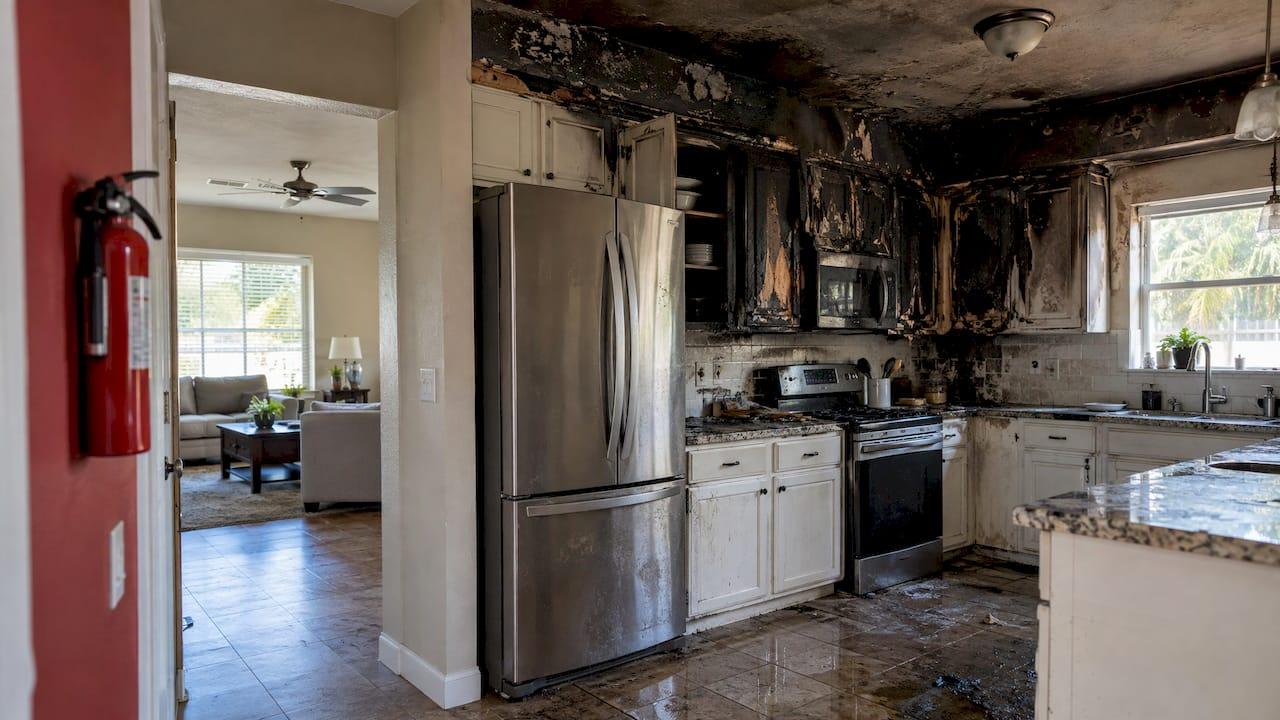
Fire Damage Restoration Cost: What Homeowners Pay

Most published figures put fire damage restoration at $4 to $7 per square foot for cleanup and repair. That works out to a few thousand dollars for a contained kitchen fire and tens of thousands once smoke, firefighting water and a rebuild are involved. A national average hides the number that matters, which is your own scope of work, written down line by line before anyone removes anything from your house. We are Ready 2 Inspect, a licensed family-owned restoration company in Lake Mary. This guide shows what drives the bill, what each part usually costs, and how to read an estimate before you sign it.
TL;DR
- Forbes Home reports a national average of $12,900 for fire damage repair, with a range from $1,200 for a small partial-home job to $72,300 for whole-home repairs.
- Cleanup runs about $4.25 to $6 per square foot. A 2,000 sq ft home averages $8,500 to $12,000 for cleanup alone, before any rebuild.
- Smoke, soot, odor, firefighting water and code upgrades are the line items that push a bill up. Rebuilding is priced separately from cleanup.
- Your deductible comes off what the insurer pays. In Florida you must report a property claim within one year of the loss.
- Ask for a written scope and cash price before work starts, so you know the number whether or not insurance pays.
Table of Contents
- What fire damage restoration costs on average
- What fire restoration, smoke cleanup and fire damage repair each cover
- What pushes a fire restoration bill up
- How to read a fire damage repair estimate
- How insurance changes what you actually pay
- A worked example: a 2,000 sq ft Central Florida home
- Why one company for cleanup, rebuild and claim
- Our approach to pricing a fire loss
- Next step for a fire or smoke loss
- FAQ
- Sources
What fire damage restoration costs on average
The most widely cited national figure comes from Forbes Home’s fire damage cost guide. It reports an average of $12,900. The range runs from $1,200 for minor restoration of part of a home to $72,300 for whole-home repairs that include a kitchen or a roof. The same guide puts restoration at $4.25 to $6 per square foot.

A square-foot rate is a rough check, not a quote. It assumes a typical mix of soot cleaning, deodorizing and light repair. It does not know whether your fire started in a grease pan or an attic wiring fault, or whether the fire department soaked three rooms.
American Family Insurance, citing Thumbtack data, says that restoring a home after a small fire averages $3,000 to $5,000. Fires that destroy a roof or kitchen can reach $50,000 and up. Its smoke damage cleanup cost article puts typical post-fire cleanup between $3,000 and $26,000.
Those sources agree on the shape of the cost curve:
| Fire size | What it usually means | Typical cost |
|---|---|---|
| Small, contained | One appliance or one area of a room, smoke limited | About $1,200 to $5,000 |
| Mid-size | A full room, smoke through the house, some water | Often $8,000 to $26,000 including cleanup |
| Large | Kitchen or roof destroyed, structural repair | $50,000 and up |
| Whole-home | Heavy structural loss and rebuild | Up to $72,300 for repairs in the Forbes range, far more for a total-loss rebuild |
For a total-loss rebuild, Forbes cites about $180 to $450 or more per square foot, against about $50 per square foot for a partial rebuild. Use these figures to judge whether an estimate is in the right neighborhood. Do not use them to predict your own number.
What fire restoration, smoke cleanup and fire damage repair each cover
The search terms overlap, but the work is different. Estimates get confusing when one contractor prices only cleanup and another prices cleanup plus rebuilding.
- Cleanup and restoration: removing soot, smoke residue and odor, drying anything wet, and clearing burned material.
- Repair and reconstruction: replacing drywall, flooring, cabinets, wiring, insulation and roofing so the house is livable again.
Forbes breaks cleanup into line items:
| Line item | Typical cost |
|---|---|
| Smoke damage cleanup | $200 to $900 |
| Water damage from firefighting | $1,000 to $4,600 |
| Soot removal | $1,400 to $4,700 |
| Removal of damaged items | $55 to $80 per pound |
| Furniture deodorizing | $600 to $2,000 |
| Duct cleaning | $200 to $500 |
| Ozone treatment | $200 to $500 per floor |
| Thermal fogging | $200 to $600 per floor |
American Family puts smoke remediation alone at $200 to $1,000. It puts an HVAC evaluation at $150 to $500, with repairs upwards of $1,000.
The rebuild comes after cleanup. Forbes lists these ranges for common repairs:
- Drywall replacement: $400 to $2,400
- Roof repair: $400 to $1,400, or $2,500 to $5,400 for a full or partial replacement
- Electrical wiring: $900 to $3,000
- Insulation: $2,100 to $6,700
- Flooring: $400 to $20,000
- Kitchen remodel after a grease fire: $13,500 to $60,000
- Permit and inspection fees: from several hundred to several thousand dollars
The flooring range is wide because it depends on what you had. Carpet in one bedroom and hardwood through a first floor are different jobs.
What pushes a fire restoration bill up
Two houses with the same square footage can land at very different totals. These are the usual reasons.
Smoke and soot type
A grease fire leaves oily residue that smears and is harder to remove than the dry soot from burned paper or wood. Smoke that reaches the air conditioning system, wall cavities or insulation raises both cleaning and deodorizing costs, according to AlliedPA’s restoration guide. In Central Florida the air handler matters even more. It runs most of the year, so it moves smoke through the whole house within minutes.
Water from putting the fire out
Firefighting water soaks drywall, insulation and flooring. Wet materials need extraction and structural drying, and they can become a mold problem if they stay wet. In Florida’s humidity that happens fast. The same guide lists heavy firefighting water as a driver of drying, extraction and possible mold remediation costs. Our page on water damage restoration explains the drying side of that work.

Time before work starts
Soot corrodes surfaces, and smoke odor sinks deeper into porous materials the longer it sits. Restoration professionals commonly recommend starting within 24 to 48 hours. A delay does not change the price on the first day, but it can widen the scope by the end of the week.
Code upgrades and permits
A rebuild has to meet the current building code, not the code from the year your house was built. Upgrades to electrical, insulation or fire stopping can appear as separate line items. Ask whether your policy has a code upgrade provision, since that is often where those costs are covered.
How many trades are involved
A fire job can need demolition crews, smoke specialists, drying technicians, framers, electricians, plumbers, HVAC technicians, drywallers, painters and flooring installers. Every handoff between companies is a place where a scope item gets dropped or paid for twice. That coordination is a big part of why fire losses cost what they do.
How to read a fire damage repair estimate
A useful estimate is specific. FEMA’s homeowner’s guide to residential smoke damage advises checking the contractor’s license, bonding and liability insurance, and IICRC or RIA certifications. It also advises getting a written estimate and contract with the project amount and the start and completion dates before work begins.
Before you accept any estimate, check that it does the following:
- Lists work by room. Each line names the location, the damaged material and the action: clean, repair or replace.
- Separates cleanup from rebuild. You should see two numbers, so you can compare like with like.
- Says how odor is handled. Removing the source and residue is different from covering the smell. Ozone, hydroxyl treatment and thermal fogging all appear as line items. Ask which one is used and where.
- Covers the air conditioning system. If smoke reached it, the estimate should say whether the ducts and air handler are cleaned or evaluated.
- Names permits and code items. If the work needs a permit, it should appear.
- States who does the work. Ask whether the company’s own people do it or subcontractors do.
Restore or replace
For burned framing, the decision between cleaning the char off and replacing the member depends on how much of the member is left and what each option costs. Restoration Intel’s structural fire damage guidance describes restoring when the member is still structurally adequate and restoration costs well under replacement, roughly under 50 to 60 percent. An engineer’s sign-off should come before rebuilding moves ahead. If the damage is so extensive that you are weighing what to do with the house itself, selling a water damaged house is one path some owners consider, and the same restore-or-replace thinking applies to it.
How insurance changes what you actually pay
With fire, the question is rarely whether insurance applies. It is how much of the bill the policy absorbs and what you pay out of pocket.
Under a standard HO-3 policy, your deductible applies to fire and smoke claims. MoneyGeek’s deductible guide gives an example: with $18,000 in damage and a $1,000 deductible, the insurer pays $17,000. If the damage is below the deductible, the insurer pays nothing, and the claim may still show on your CLUE report, the claims history insurers check.
Four things protect your claim in the first days:
- Report it on time. Florida law requires notice of a property insurance claim within one year of the date of loss, under Florida Statute 627.70132. Do not wait for the full scope to be known.
- Protect the property. Your policy expects reasonable steps to prevent further damage, such as boarding up openings or tarping a roof. Keep the receipts. The North Carolina Department of Insurance consumer guide describes the same general duty: make reasonable emergency repairs, keep receipts and photograph the damage before and after.
- Document before you clear. Photograph and list everything. Avoid extensive repairs before the adjuster has seen the damage.
- Check your own policy. Deductibles, code upgrade provisions and time limits differ. Your policy and your insurance company or agent are the final word on what is covered.
A caution on one thing: FEMA advises contacting your insurance company before retaining a cleaning service. That is the right order. Report first, then decide who does the work.
A worked example: a 2,000 sq ft Central Florida home
Take a kitchen grease fire in a 2,000 sq ft single-story home. The fire is out, but smoke has traveled through the air handler and the fire department used a lot of water. These figures are illustrations built from the published ranges above. They are not a quote and not a Ready 2 Inspect price.
| Part of the job | Illustrative range from the sources |
|---|---|
| Whole-house cleanup at $4.25 to $6 per sq ft | $8,500 to $12,000 |
| Water extraction and drying | $1,000 to $4,600 |
| Duct cleaning | $200 to $500 |
| Kitchen rebuild after a grease fire | $13,500 to $60,000 |
The cleanup figure is the whole-house estimate and the water line is a separate line item, so some overlap is likely in a real estimate. Read the example as a sense of scale. The rebuild, not the cleanup, is where the total moves most. With a $1,000 deductible and a covered loss, you would pay the deductible and the insurer would cover the rest of the approved scope. With no insurance, you pay the cash price, which is why a written number up front matters so much.
Why one company for cleanup, rebuild and claim
Fire work usually splits across companies. One handles cleanup, another rebuilds, and you handle the insurer in between. Each split is where responsibility gets blurry: who dried the wall, who closed it, who owns a smell that returns.
That is the problem we built the company around. Ready 2 Inspect is licensed for the reconstruction as well as the cleanup. The company that opens the wall is the one that closes it, covering drywall, tile, cabinets, counters, flooring and trim. We also run the insurance claim end to end, and you deal directly with the owner, John Foutz. He is a Florida licensed mold assessor and mold remediator and was a Florida home inspector for close to a decade before starting the company.
Our approach to pricing a fire loss
Most people call after a fire in the worst possible state of mind. They are looking at a black kitchen and worrying about a bill they cannot see yet. The first thing I want them to know is the sequence: nothing comes out of the house until everyone knows who is paying for it.
That means the cash price is on the table before the claim is filed. I lay out every outcome, including the one where insurance pays nothing. Then you decide, and work starts only after you have. If you have no insurance, I still take the job and give you the price in writing. I do not quote people out of the running.
The second thing is that smoke is not a one-room problem in a Central Florida house. The air conditioning pulls it everywhere. So I look at the whole house, not only the room that burned. And the same licensed company does the cleanup, the rebuild and the paperwork. You are not meeting a stranger halfway through the job.
You call, I answer, and I come out myself.
John Foutz
Next step for a fire or smoke loss
If you have had a fire in Lake Mary, Seminole County or nearby parts of Orange, Volusia or Lake counties, our fire and smoke restoration service covers soot removal, odor treatment at the source and the rebuild under one licensed company. You can also see how the full range of work fits together on our restoration services page. Call before anything is removed, so you have the price and the insurance picture first.

If water is also an issue from firefighting or a burst line, our water damage restoration cost guide shows how that part of the bill is built.
FAQ
How much does fire damage restoration cost per square foot?
Forbes Home puts fire restoration at $4.25 to $6 per square foot, so a 2,000 sq ft home averages $8,500 to $12,000 for cleanup. Rebuilding is priced on top of that. A partial rebuild runs about $50 per square foot and a total-loss rebuild about $180 to $450 or more.
How much does smoke damage cleanup cost?
Smoke cleanup alone is commonly listed at $200 to $1,000. Soot removal, odor treatment and duct work are priced separately. Smoke that has traveled through the air conditioning system or into wall cavities raises the total, so ask for each item in writing.
Does homeowners insurance pay for fire damage cleanup and repair?
A standard HO-3 policy generally covers fire and smoke damage, minus your deductible. With $18,000 in damage and a $1,000 deductible, the insurer pays $17,000. Your own policy sets the terms, so read it or ask your insurance company. In Florida, report the claim within one year of the loss.
How soon should restoration start after a fire?
Restoration professionals commonly recommend starting within 24 to 48 hours. Soot keeps corroding surfaces, wet materials can grow mold, and smoke odor soaks deeper into porous materials as time passes. Report the claim and protect the property first, then arrange the work.
What should a fire damage repair estimate include?
It should list each room, the damaged item and whether it is cleaned, repaired or replaced. It should separate cleanup from rebuild, name the odor method and show permits. FEMA also advises a written contract with the amount and the start and completion dates.
Sources
- How Much Does Fire Damage Restoration Cost? – Forbes Home
- Smoke damage clean-up and restoration costs – American Family Insurance
- What Is Fire Damage Restoration? Complete Guide – AlliedPA
- Homeowner’s Guide to Risk Reduction and Remediation of Residential Smoke Damage – FEMA
- Structural Fire Damage Assessment & Char Removal – Restoration Intel
- Average Home Insurance Deductible – MoneyGeek
- Florida Statute 627.70132, Notice of property insurance claim – The Florida Senate
- Homeowner’s Insurance consumer guide – North Carolina Department of Insurance
- Selling a Water Damaged House: Your Options and Next Steps