
Mold on Furniture: How to Clean It and When to Let It Go
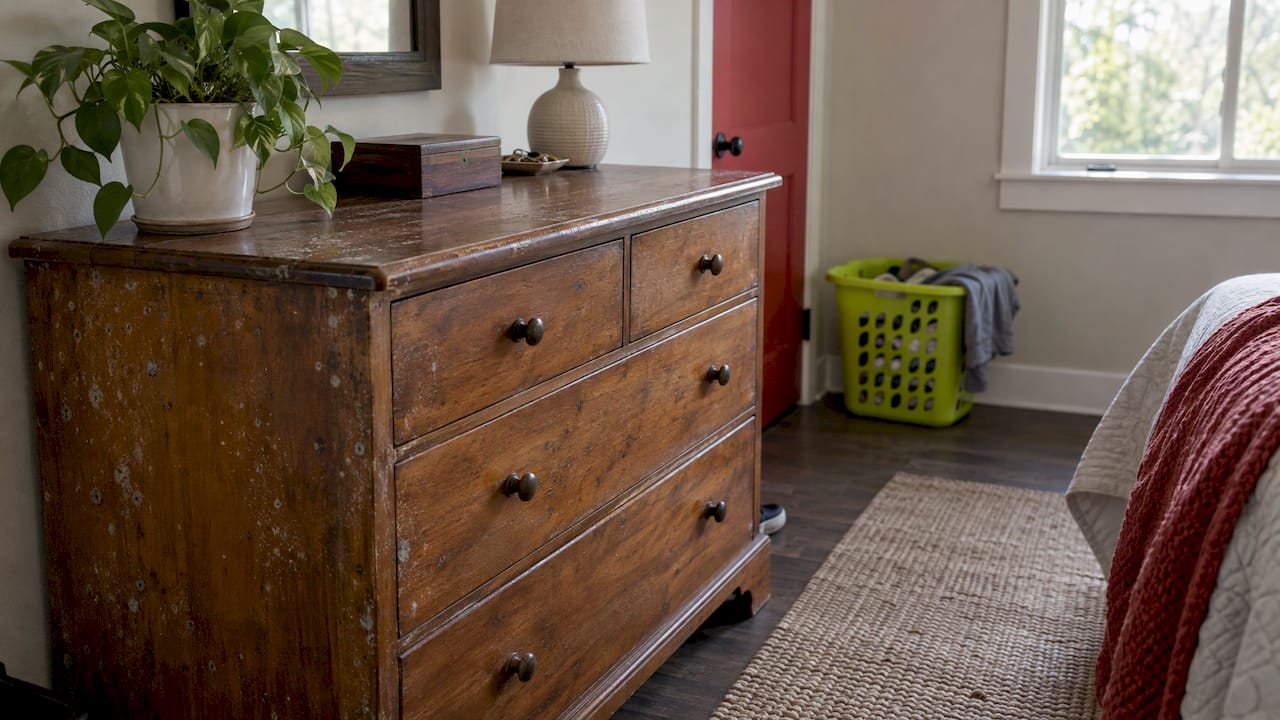
Mold on furniture means the piece got damp and stayed that way, so the first job is finding the moisture, not just wiping the spots. Finished solid wood can usually be cleaned with detergent and water. Upholstery, particle board and anything that soaked through is a different story: it is often cheaper to discard than to save. If the same room has a musty smell, a stain on the wall or a leak history, the furniture is probably a symptom, and we are glad to look at the room for free.
I’m John Foutz, a licensed Florida mold assessor and remediator. Below is the routine I would give a neighbor: how to recognize it, how to clean what can be cleaned, where to stop, and how to keep it from coming back in a humid Central Florida house.
TL;DR
- Mold grows on wood, fabric and upholstery wherever there is moisture, and it usually looks like spots in many colors with a musty smell, per the CDC.
- Finished or solid wood can be scrubbed with mild detergent and water, then dried completely. Wear an N95 respirator, gloves and goggles.
- Upholstery, mattresses and particle board that grew mold are seldom worth saving. If a piece stayed wet past 48 hours, plan on replacing it.
- Never mix bleach with ammonia or vinegar, and never paint or seal over mold.
- If people with asthma, allergies or a weak immune system live in the house, they should stay out of the cleanup. Call us for a free inspection when the problem looks bigger than one piece.
Table of Contents
- How to tell mold on furniture from dirt or old finish
- Why furniture grows mold in Florida homes
- Before you clean: safety first
- How to clean mold off solid wood furniture
- Upholstered furniture, mattresses and particle board
- A musty smell with no visible mold
- When to stop and get help
- Do not paint, seal or spray over it
- Keeping mold off furniture for good
- Our view: furniture is usually the symptom
- When it’s more than one piece of furniture
- FAQ
- Sources
How to tell mold on furniture from dirt or old finish
Before you scrub, confirm what you are looking at. The Minnesota Department of Health describes mold as cottony, velvety, granular or leathery, in white, gray, brown, black or green, usually with a musty or earthy odor. OSHA describes it as distinctly colored woolly mats, often with a foul musty smell.
Three quick observations help:
- Texture. Dirt and finish wear are flat. Mold sits on the surface in fuzzy, powdery or speckled patches.
- Location. Mold favors the back of a dresser against an exterior wall, the underside of a table, drawer interiors, and anything touching a floor that has been damp. The Minnesota brochure advises looking behind and underneath furnishings, under carpet and pad, and in sink cabinets.
- Smell. A musty or earthy smell that gets stronger when you open a drawer or pull a cushion out is a strong clue, even when you cannot see growth.
A dresser bought secondhand with dark marks inside the drawers is a common case. If the marks are just where hands and wear have darkened the wood, they will not be fuzzy and the piece will not smell musty. If they are fuzzy, speckled or smell earthy, treat it as mold.
Why furniture grows mold in Florida homes
Mold needs moisture and something organic to eat. Wood, fabric, leather and stuffing are all food. The CDC says mold grows where moisture collects, such as around roof, window or pipe leaks or after flooding, and the same page lists wood, fabric and upholstery among the materials it grows on.
In Central Florida, the usual causes are:
- A slow leak behind a wall, under a sink or from a water heater that wets the floor beside the furniture.
- A roof or window leak that drips down an exterior wall, where a couch or dresser sits flush against it.
- An air conditioner that cannot keep up. Furniture pushed tight against walls or vents sits in still, humid air.
- Storage in a garage, attic or enclosed porch. The Florida Cooperative Extension Service says humidity moves through wood and causes swelling, cracked finishes and warping, and advises against storing furniture in uncontrolled areas such as attics, garages and enclosed porches.
- A flood or plumbing event that wasn’t dried out in time. The EPA says mold will not usually grow if wet items are dried within 24 to 48 hours.
That last point matters most. If your furniture was wet and now has mold, the clock ran out somewhere. Finding where the water came from is the real fix.
Before you clean: safety first
Cleaning mold stirs up spores. The CDC’s cleanup guidance says people with allergies, a weakened immune system, underlying lung disease, asthma or COPD should not take part in mold cleanup. Everyone else should wear at least a NIOSH-approved N95 respirator, non-latex gloves and dust-proof goggles.
Set up like this:
- Move the piece outdoors if you can, or into a garage with the door open. Do not drag it through the house.
- Do not point a fan at it while mold is still on the surface. The CDC’s disaster guidance warns that fans can spread spores once mold has started growing.
- Put on the respirator, gloves and goggles before you touch it.
- Keep a trash bag handy for rags and brushes you will not reuse.
And one rule that causes real injuries: never mix bleach with ammonia, and the University of Georgia Extension adds that bleach should never be mixed with acids such as vinegar either. Pick one product and use it alone.
How to clean mold off solid wood furniture
Wood that is solid, finished and not soaked through can often be cleaned. The EPA says treated or finished wood can be cleaned with mild detergent and clean water and then allowed to dry. NC State Extension gives the same approach for hard-surfaced wood furniture: a damp rag and water with a mild non-phosphate detergent.
The steps
- Take it outside and put on your protective gear.
- Dry-wipe loose growth gently, or vacuum it with a HEPA-filter vacuum if you have one. Dispose of the contents in a sealed bag.
- Wipe with a barely damp cloth and a solution of water and mild non-phosphate detergent. Work in small sections and rinse the cloth often. Use a soft brush for carved edges and corners. Do not soak the wood.
- Wipe again with a cloth dampened in clean water to remove detergent residue.
- Dry completely in a well-ventilated spot, but out of direct sunlight, which NC State warns can warp the wood. The University of Georgia says to finish drying within 48 hours, using dehumidifiers and fans to bring relative humidity to 30 to 50 percent. Fans are fine at this stage because the surface mold is gone.
- Check drawers, backs and undersides and clean those as well. Mold hides where you do not look.
- Bag the used rags and wash your hands and clothes.
What about bleach, vinegar and borax?
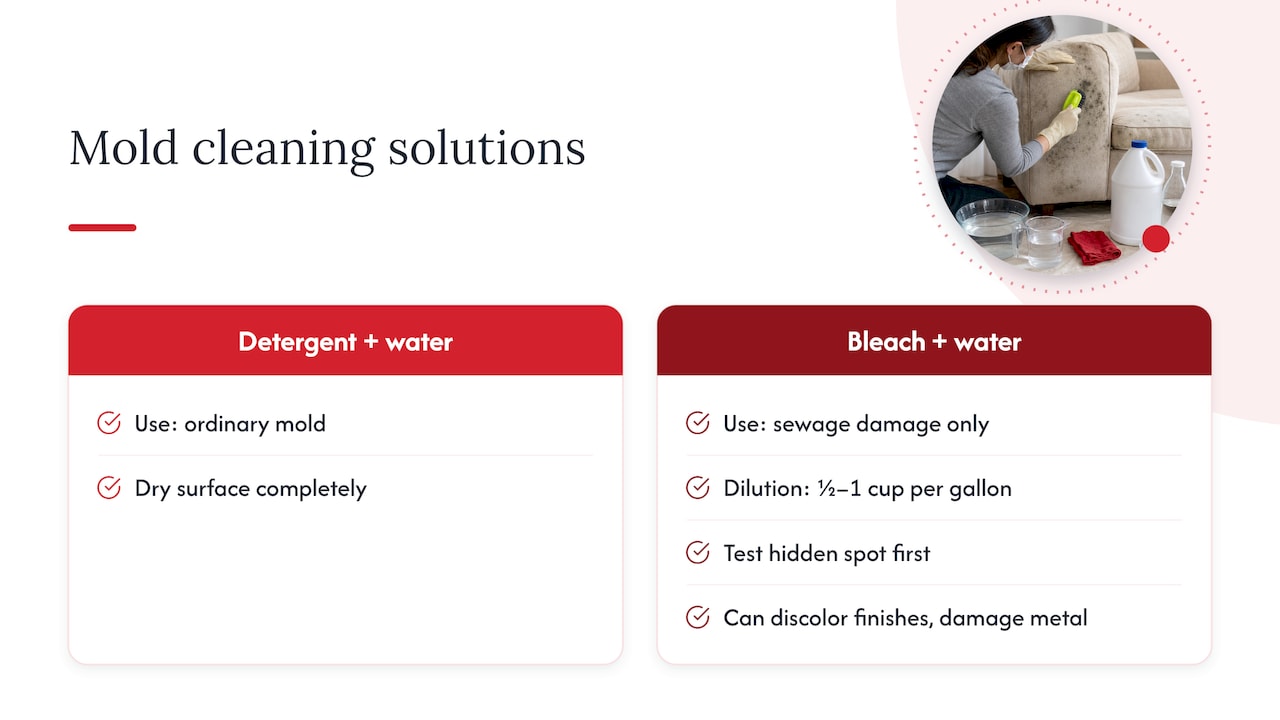
For ordinary mold on a dry piece, detergent and water is the method the EPA and NC State describe. NC State says to disinfect with bleach and water only when the damage came from sewage water. If you do use bleach in that case, the University of Georgia says to use half a cup to one cup per gallon of water, test it on a hidden spot first, and never mix it with ammonia or acids. Bleach can also discolor finishes and damage metal hardware.
Whatever product you choose, the point is the same: the surface has to be cleaned and then dried completely. A cleaner that leaves the wood damp feeds the problem.
Sanding and refinishing
If the finish is cloudy or stained after cleaning, a light refinish can restore it. Only do this once the wood is bone dry, and wear the respirator for the sanding dust. If you see dark staining that goes into the grain, the EPA notes that mold can infiltrate crevices and also cause staining, so some marks will remain even after the mold is gone.
Upholstered furniture, mattresses and particle board
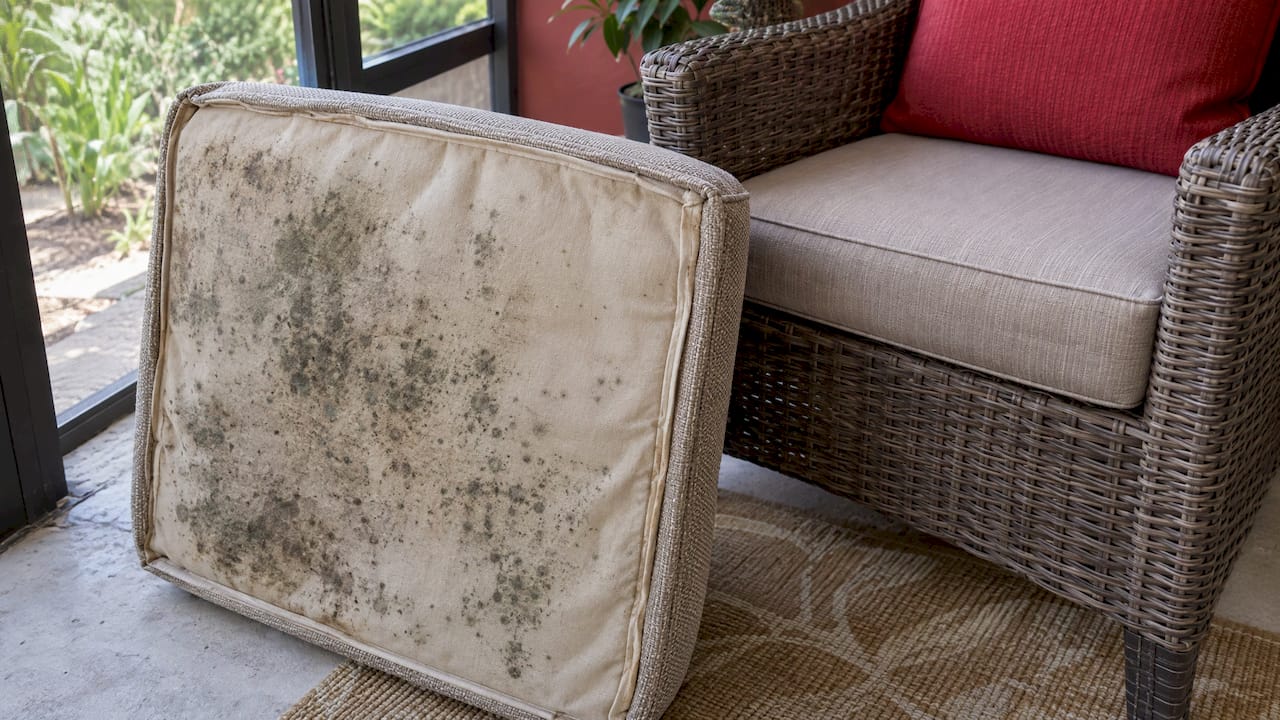
This is where most people lose time. Porous materials hold moisture and growth deep inside. The Minnesota brochure says porous materials growing mold, including carpet, upholstery and particle board, should be bagged and thrown away. NC State says upholstered furniture and mattresses are seldom salvageable once water and mold have damaged them.
There are exceptions, and they depend on how long the piece was wet and with what:
- Clean water, caught fast. NC State says an item with sentimental value, or one that touched clean water for less than a few hours, may be restored by stripping it to the frame, disinfecting the frame and reupholstering after it is completely dry.
- A small surface patch with no odor. The Washington State Department of Health says non-washable furniture can be vacuumed well and aired out. If there is no odor it may be fine, but watch for regrowth and discard it if mold is suspected inside or outside the item.
- Valuable pieces. The EPA notes that drying upholstery completely within 48 hours can be hard, and that a valuable piece may justify a furniture-specialist restoration professional.
Flood water changes the answer. The CDC’s guide says to throw away anything wet with flood water that cannot be cleaned and dried completely within 24 to 48 hours. That includes sofas and mattresses that sat in a backed-up toilet or sewage overflow. Our pages on toilet overflow cleanup and sewage backup cleanup cover the first hour.
A practical rule: if you press the cushion and smell mold from the inside, or you see growth under the fabric, the piece goes. Wrap it in plastic before you carry it out so spores do not spread through the house.
A musty smell with no visible mold
A musty smell on furniture, with nothing to see, still means moisture is present somewhere. Check in this order:
- The furniture itself. Pull drawers, flip cushions, look at the underside and the back panel.
- The wall and floor behind it. Feel for cool, damp or bubbling drywall, and look at the baseboard. Our guide on mold behind a baseboard explains what to do before you pull one off.
- The air conditioning. Condensation at vents and a humid room point to an HVAC problem, covered in our guide to condensation on AC vents.
- Roof and ceiling. A slow roof leak can wet a wall for weeks. See roof leak mold.
If the smell is in one piece and goes away after cleaning and thorough drying, the furniture was the whole problem. If it returns in a few days, or follows the room rather than the piece, something in the structure is wet. That is when a licensed assessor is worth a visit. The CDC does not recommend relying on testing as a first step, since there are no set standards for acceptable mold quantities in a home. A visual inspection and moisture readings tell you where the water is, which is what you need to fix.
When to stop and get help
Stop cleaning and call someone if any of these is true:
- The growth covers more than the one piece, or it is on the wall, ceiling or floor behind it.
- The furniture was wet from a leak you have not found or fixed.
- Someone at home has asthma, allergies, a weakened immune system or lung disease. The CDC says those people should stay out of mold cleanup.
- The smell is still there after the piece was cleaned and dried.
- You see growth inside a wall cavity, under flooring or on insulation.
Ohio State’s environmental health office, applying the EPA’s remediation tables, points out that the square-footage thresholds in those tables are convenience guidelines for choosing techniques, not health-based cutoffs. Hidden or extensive mold calls for professional judgment and containment. So “it’s only a small patch” is not the test. The test is whether you know where the moisture came from and whether it is gone.
If you or someone in the house has symptoms such as congestion, headaches or worsening asthma, see a doctor about those symptoms. We cannot diagnose anything, and neither can a cleaning routine. Our page on mold exposure symptoms and warning signs explains what we can and cannot say.
Do not paint, seal or spray over it
The CDC says not to paint or caulk over mold. Coating a moldy piece, or a moldy wall behind it, hides the growth without removing what feeds it. If someone quotes you a spray-only or sealing fix, read our comparison of mold encapsulation versus removal first.
Keeping mold off furniture for good
Prevention is mostly humidity control and fixing leaks.
- Keep humidity down. The CDC says to keep indoor humidity no higher than 50 percent all day, using an air conditioner or dehumidifier. The Florida extension service gives a 30 to 50 percent range, and 60 to 80°F, for protecting furniture.
- Give pieces room. Pull furniture a few inches off exterior walls so air can move. Do not place it directly in the path of registers, heaters or air conditioners.
- Don’t store furniture in uncontrolled spaces. Garages, attics and enclosed porches swing from hot to humid.
- Fix the source. The CDC lists roof, wall and plumbing leaks first. Water getting past damaged roof edges is a common one, and repairs like fascia and soffit repair stop moisture from entering the wall in the first place.
- Dry fast after a leak. Remove standing water, run dehumidifiers and fans, and get everything dry inside 24 to 48 hours. For wet hardwood, see our guide to the first 48 hours on wet hardwood floors.
- Choose treated fabrics when you replace. Kansas State Extension says textiles finished with moisture repellents and bacteriostats resist mildew better.
Our view: furniture is usually the symptom
Most people who call us about mold on furniture have already cleaned the piece once. The mold came back because the wall behind it, or the air handler down the hall, was still feeding it.
We tell homeowners to do the part they can do well: clean solid wood, discard the sofa that sat wet, and keep the humidity down. If you are going to do it yourself, I will give you the instructions, in detail. The thing I will not do is guess about what is inside a wall.
That is why I come out myself to look. I hold Florida licenses as both a mold assessor and a mold remediator, and I worked as a home inspector for close to a decade before starting the company. When the furniture is one piece, I will tell you so. When it is the first sign of a wet cavity, I will show you where.
The other part of how we work is sequence. Nothing comes out of your house until you know who is paying for it. If insurance may be involved, we lay out the cash price and every possible outcome first, including the one where insurance pays nothing, and work starts only once you decide. The same company can then do the cleanup, the rebuild of drywall, trim, flooring, cabinets and counters, and the claim paperwork, so you are not coordinating three businesses.
John Foutz
When it’s more than one piece of furniture
If the moldy piece sits against a wall that is stained, soft or smells musty, we start with a free mold inspection. You deal directly with John, who answers the phone and comes out himself. If the inspection finds a problem, our mold remediation service covers the cleanup, and we are licensed for the reconstruction afterward, so the same company that opens the wall closes it. For active water, water damage restoration starts the drying that keeps a wet cavity from becoming a mold job.

You can book the free mold inspection or call us directly. We serve homes across Seminole, Orange, Volusia and Lake counties from our base in Lake Mary.
FAQ
Can I save a moldy wooden dresser or table?
Often yes, if it is solid or finished wood that was not soaked. Clean it with mild detergent and water as the EPA describes, wipe it clean, and dry it fully within about 48 hours. If the wood is warped, crumbling, or the mold has gone into particle board or veneer, replacing it is the better route.
Will vinegar kill mold on wood permanently?
No single wipe makes a surface mold-proof, because mold returns whenever moisture does. The extension and EPA guidance centers on detergent and water followed by thorough drying. Never combine vinegar with bleach, since the University of Georgia warns against mixing bleach with acids.
What should I not clean mold with?
Never mix bleach with ammonia or with acids such as vinegar. Do not use bleach on metals, and test it on a hidden spot before using it on any finish. Avoid soaking wood, which gives mold the moisture it wants.
Is a musty smell on furniture dangerous?
A musty smell tells you there is moisture and possibly growth. It does not tell you what is happening to anyone’s health. People with asthma, allergies or lung disease should stay out of cleanup, and anyone with symptoms should speak to their doctor.
Should I throw away a moldy couch?
Usually, yes, if mold is inside the cushions or frame or the couch was wet for more than 48 hours. NC State Extension says upholstered furniture is seldom salvageable after water and mold damage. A piece with sentimental or high value, wet briefly with clean water, may be worth a furniture restoration specialist.
Sources
- CDC: Mold
- CDC: Mold cleanup guidelines and recommendations
- CDC: Homeowner’s and Renter’s Guide to Mold Cleanup After Disasters
- Minnesota Department of Health: Mold and Moisture Brochure
- OSHA: Mold factsheet
- US EPA: Mold Course Chapter 4
- NC State Extension: Removing Mold From Household Items
- University of Georgia Extension: Removing Mold in Your Home
- Washington State Department of Health: Mold FAQ
- Florida Cooperative Extension Service: Protecting furniture
- Fascia and soffit repair