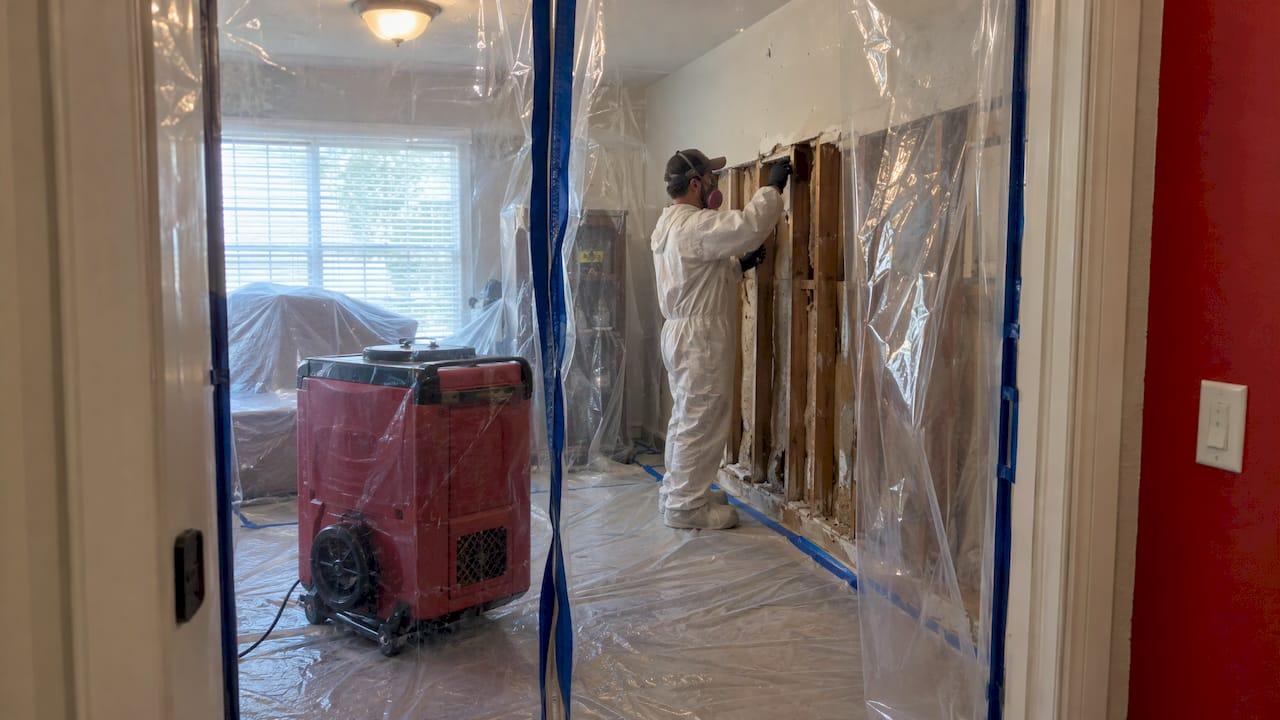
Mold Remediation Process: Steps From Inspection to Rebuild

Professional mold remediation is a sequence: find and stop the water, contain the area, remove the mold and the materials that can’t be cleaned, dry everything, verify the result, then rebuild what was opened. The order matters more than the equipment. Skip the first step and the mold returns, whatever you spray on it. I’m John Foutz, a licensed Florida mold assessor and remediator, and this is how the job runs when it is done properly, including where it goes wrong and what you should know before anything comes out of your house.
TL;DR
- Remediation removes mold and fixes the moisture that fed it. Killing mold in place is not the goal, because dead mold can still cause allergic reactions.
- The core steps are: assess, fix the water source, contain, remove and clean, dry, verify, rebuild.
- The EPA says homeowners can usually handle a patch under about 10 square feet. Larger areas, or a lot of water damage, call for a professional.
- Florida licenses mold assessors and remediators separately, so check the license number before you sign.
- Before work starts you should know who pays, what it costs in cash, and what happens if insurance pays nothing.
Table of Contents
- What remediation is, and what it is not
- The steps, in order
- How long does it take?
- Small patch or professional job?
- Who should do the work in Florida
- Money and insurance: settle it before demolition
- Start with a free inspection
- FAQ
- Sources
What remediation is, and what it is not
Wiping a visible spot is cleaning. Remediation is a controlled job with a plan. The EPA’s guidance for professional remediation says the purpose is to remove mold, not just kill it, since dead mold is still allergenic and some dead molds are potentially toxic. It also says a building can’t be sterilized: a background level of spores about equal to or lower than outdoor air will remain, and it will not grow if the moisture problem is solved.
That last point is the whole job. Mold is the symptom. Water is the cause. A crew that removes mold and leaves the leak, the wet insulation or the failing drain line has sold you a repeat visit.
The steps, in order
The EPA’s key steps for professional remediation run from assessing the problem and identifying the moisture source, through planning protective equipment and containment, to cleaning, drying and checking for returning mold. Here is how that looks in a Central Florida house.
1. Inspect and map the damage
The first visit answers three questions: how much is affected, what materials are involved, and where the water came from. Drywall, carpet, wood framing and insulation are handled differently, so the material decides the plan. Visible growth is often the edge of the problem. Mold behind a baseboard usually means a wet wall cavity, which is why what to do before you pull a baseboard off matters: pulling it carelessly can spread spores into the room.
The EPA notes that when mold is visible, sampling is usually unnecessary, and that no federal limits exist for mold or spores, so a lab number can’t prove compliance with a federal standard. Sampling has a place, though. Surface sampling may help show whether an area was adequately cleaned, and it should be done by people with specific experience. Our inspection is free, and laboratory testing and air sampling are available when the situation calls for them.
2. Find and stop the water
This step comes before any removal. NIH’s remediation procedure says the water source must be managed so water is no longer infiltrating when remediation begins. In Florida the usual culprits are:
- supply lines, water heaters and dishwasher hoses
- roof leaks that soak insulation and ceilings (see our page on roof leak mold)
- air conditioner drain lines and condensation around the air handler
- plumbing behind tile and cabinets
A musty smell with nothing visible is a clue to a hidden source, and the principle applies there too: fix the moisture before treating the odor. Deodorizing a wet wall only hides the problem.
If the air conditioning system may be contaminated, the EPA says not to run it, because it could spread mold through the house.
3. Plan, protect and contain
Before demolition the crew decides what protective gear is needed and how to keep spores from traveling. On a typical job that means plastic barriers sealing the work area, and air filtration that pulls air through HEPA filters (high-efficiency filters that trap very small particles). A federal specification for mold remediation, UFGS 02 85 00, calls for polyethylene barriers and HEPA units holding the work area at slight negative pressure, with dehumidifiers keeping relative humidity below 60 percent. The same document warns that in humid climates too much negative pressure can pull in moist outside air and cause more mold, so the balance is deliberate. That is a real consideration in Florida.
Workers wear respirators, gloves, eye protection and disposable coveralls. The NIEHS guidance names an N95 respirator as the minimum and a half- or full-face respirator when contamination goes beyond small scale.
4. Remove and clean
Materials that are moldy and porous, such as wet drywall, insulation and carpet padding, generally come out and are bagged before leaving the containment. Hard surfaces and framing are cleaned and dried. The EPA says moldy items that can’t be cleaned should be discarded.
This is also where the paint-over question gets answered. CDC’s guidance on mold remediation warns that painting over water-damaged materials or moldy surfaces can cause further problems. A coating hides growth that is still alive behind it, and it will come back through. If a quote is spray-only or seal-only, compare it to this sequence. We cover the tradeoff in mold encapsulation vs removal.
5. Dry everything
Drying is where most failed jobs fail. The EPA says drying wet materials within 24 to 48 hours of a leak or spill prevents mold in most cases. The NEHA guide adds that porous materials such as carpet that stay wet beyond that window might need to be discarded. Dehumidifiers and air movers run until the readings match unaffected parts of the house, not until the surface feels dry. Wet cavities need mapping first; see wall cavity drying.
If the cause was a fresh leak, starting drying the same day is the cheapest mold remediation there is. Our water damage restoration work is meant to catch the wet cavity before it becomes a mold job.
6. Verify that it worked
A job is finished when the moisture problem is fixed, visible mold and odors are gone, and a follow-up visit finds no new water damage or growth, according to the EPA. NEHA’s post-remediation checklist adds humidity within 30 to 50 percent, dry materials compared with unaffected reference areas, no musty odor and the HVAC inspected and cleaned if necessary. Larger jobs may add surface or air sampling afterward, as the federal specification does before containment comes down.
7. Rebuild
Opening walls means closing them again: drywall, trim, flooring, cabinets, counters, tile. Most remediation companies stop at the demolition and hand you to a separate contractor. We are licensed for the reconstruction too, so the company that opened the wall is the one that closes it, under the same claim. If a national brand left your job halfway at demolition, this is the part we can pick up.

How long does it take?
The honest answer is that it depends on three things: the square footage affected, how many materials have to come out, and how long drying takes. A small, accessible patch is a short job. A wet wall cavity, a ceiling or an air handler involvement adds time, and rebuilding adds more. The one hard number in the process is the drying window of 24 to 48 hours after water arrives, which is why the first call matters more than any other part of the schedule.
We give you the scope and the timeline in writing after the inspection, before work starts, because the timeline depends on what we find behind the surface and not on a guess over the phone.
Small patch or professional job?
The EPA says that if the moldy area is less than about 10 square feet, roughly a 3 by 3 foot patch, a homeowner can usually handle it. Above that, or after a lot of water damage, it points to its professional remediation guidance. Sewage or other contaminated water is a job for a professional.
If you do clean a small patch, the CDC lists people who should take extra care or avoid cleanup altogether: people with allergies, weakened immune systems, or chronic lung disease such as asthma or COPD. If that is you, don’t do it yourself. Wear the gear described above, keep the area contained, and stop if the growth is bigger than you thought or the material behind it is wet.
If you are going to do it yourself, I will give you the instructions in detail. Call us and ask.

Who should do the work in Florida
Florida regulates mold work under Chapter 468, Part XVI of the Florida Statutes, and the Department of Business and Professional Regulation licenses mold assessors and remediators. The CDC also tells homeowners to look for professionals affiliated with or certified by recognized bodies and notes that states may regulate the work. Ask for the license number and look it up. Our page on how to verify a licensed mold remediator walks through it. I hold Florida licenses as both a mold assessor (MRSA4802) and a mold remediator (MRSR4767).
Money and insurance: settle it before demolition
This is where homeowners get hurt, and it has nothing to do with mold. Walls come out, then the claim is denied, and you are left with an open house and a bill. Our order is different. Nothing comes out until we know who is paying. You get the cash price before the claim is filed, every outcome is laid out, including the one where insurance pays nothing, and work starts only once you have decided. If you pay out of pocket or have no insurance, you get the price in writing and we take the job. We also run the insurance claim from start to finish, so you are not translating between an adjuster and a contractor.
How we see it
The remediation process is not complicated. Almost every callback I hear about comes from the same two shortcuts: the water source wasn’t fixed, or the mold was covered instead of removed.
That is why we start with where the water came from and why I come out myself. You deal with me, not a dispatcher. The company that finds the problem is the company that fixes it, and the one that rebuilds the wall.
I’d rather you know the cost and every outcome before we open a wall than find out after. If it turns out you can handle a small patch yourself, I will tell you how.
John Foutz
Start with a free inspection
If you have found dark growth, a persistent musty smell or water that has been sitting in a wall, our free mold inspection tells you what is there and where the moisture is coming from. From there, our mold remediation service covers containment, removal, drying and the rebuild, serving Lake Mary and 25 cities across Seminole, Orange, Volusia and Lake counties, including Lake Mary.

Call and you reach me, not a call center.
FAQ
Do I need to leave my house during remediation?
It depends on the size and location of the work. Containment keeps spores in the work area, but people with asthma, allergies or weakened immune systems should talk to their doctor about staying elsewhere. We will tell you what to expect for your house at the inspection.
Can I just bleach the mold?
The EPA says that using a biocide such as chlorine bleach is not recommended as a routine practice, because dead mold is still allergenic. Mold needs to be removed, and the moisture needs to be fixed.
Is black mold dangerous?
Color doesn’t tell you what a mold is or what it does to you. The EPA lists odors, headaches, breathing difficulty, skin irritation, allergic reactions and asthma aggravation among symptoms associated with mold and moisture problems. We can’t diagnose symptoms. If you are having them, see your doctor, and we can inspect the house.
Will mold come back after remediation?
Not if the moisture problem is solved. A background level of spores remains in every home, and the EPA says it will not grow if the moisture problem is resolved. That is why the water source comes first and why a follow-up check is part of the process.
Sources
- EPA: Mold Remediation in Schools and Commercial Buildings, Chapter 3
- EPA: A Brief Guide to Mold, Moisture and Your Home
- EPA: Mold Remediation in Schools and Commercial Buildings (full guide)
- CDC: Mold Clean Up Guidelines and Recommendations
- CDC NIOSH: Mold, Testing, and Remediation
- NIH: Moisture and Mold Remediation Standard Operating Procedure
- UFGS 02 85 00 Mold Remediation
- NIEHS Disaster Recovery, Mold Remediation Guidance (eLCOSH)
- NEHA: Responding to Indoor Mold Concerns
- Florida DBPR: Mold-Related Services FAQs
- OdorCare: Musty Basement Smell and Moisture