7 Signs of a Slab Leak: Locate It Before Breaking Concrete

If you have noticed an unexplained spike in your water bill, warm or damp spots on the floor, or the sound of running water when every faucet is off, those signs often point to a slab leak. The right next step is a simple meter test, followed by a call to a professional leak locator rather than breaking concrete on your own.
TL;DR:
- Several signs together, especially a bill increase paired with running water or a warm floor patch, warrant investigation but do not confirm a slab leak.
- Turn off fixtures and irrigation, record the meter, and wait 15 to 30 minutes without using water; movement indicates water loss somewhere in the system.
- A main shutoff test separates leaks inside the home from service line leaks, while toilet dye and appliance checks can reveal simpler causes.
- Ask whether acoustic, thermal, or tracer gas tools will pinpoint the leak before concrete is cut, reducing unnecessary demolition and repair work.
- Coverage often depends on whether damage was sudden or gradual; notify your insurer early and preserve photos, bills, meter readings, and repair records.
Table of Contents
- What is a slab leak and where does it happen?
- Common slab leak signs: a homeowner checklist
- How to confirm whether the leak is under the slab
- Why early detection matters: mold, structural risk, and cost escalation
- Immediate steps to take if you suspect a slab leak
- How a licensed restoration specialist handles slab leak damage
- Owner perspective: why locating first protects the homeowner
- Get help after a slab leak: inspection, cleanup, and rebuild
- FAQ
- Sources
What is a slab leak and where does it happen?
A slab leak is a leak in a water pipe embedded in or running beneath your home’s concrete foundation. It can involve a supply line carrying hot or cold water, and in some homes it involves a sewer line under the slab.
Several things cause these leaks. Pipe corrosion over time is the most common culprit, especially in older copper plumbing. Soil shifting or settling can also stress and crack pipe joints, and poor original installation sometimes leaves a weak point that fails years later. Tree root intrusion into older sewer lines is another factor.
Because the pipe sits under a layer of concrete, you will almost never see water dripping from the source. Instead, you notice the secondary effects: a wet spot on the carpet, a warm patch on the tile, or a bill that does not match your usual water use. That is why recognizing the pattern of signs matters more than looking for a visible leak.
Common slab leak signs: a homeowner checklist
Most slab leaks announce themselves through a handful of signals. None of these confirms a slab leak on its own, but seeing two or three together is a strong reason to investigate further.
- Unexplained spike in your water bill. Compare your last two or three bills against the same months last year. A jump with no change in household habits, like a new baby, extra laundry, or guests staying over, is one of the clearest slab leak symptoms.
- Hearing running water when every fixture is off. This sound often comes from directly beneath the floor near where a main line runs, and it tends to be more noticeable at night when the house is quiet.
- Warm or cold spots on the floor. A warm patch usually means a hot water supply line is leaking underneath, since the heated water raises the slab temperature above it. A cold spot can indicate a leaking cold line in the same way.
- Persistent dampness, pooling, or staining on floors, along baseboards, or on walls near the floor line. Carpet that stays damp despite no spills, or a baseboard that discolors and warps, both point to water intrusion from below.
- Low or fluctuating water pressure throughout the house, not just at one faucet. When pressure drops at every fixture at once, water is likely escaping somewhere in the main line rather than at a single tap or appliance.
- Musty or mildew odors with no visible source. This smell often shows up before you see any staining, and it is an early signal that moisture has been sitting under flooring material long enough for mold to start.
- New cracks in the foundation, lifting tile, or doors that suddenly stick. Prolonged moisture under a slab can shift the concrete slightly, which shows up as hairline cracks, tile that pops up at the edges, or door frames that no longer line up.
Taken individually, each of these signs has other possible explanations. Taken together, especially a bill spike paired with a sound or a warm spot, they form a pattern worth checking before the damage spreads any further.
How to confirm whether the leak is under the slab
Before you call anyone, a few at home checks can rule out simpler explanations and tell you whether water is leaving your system at all.
- Run the water meter test. Turn off every faucet, appliance, and irrigation system in the house. Locate your water meter, record the reading, and wait 15 to 30 minutes without using any water. If the reading changes, water is moving through your system somewhere.
- Verify with the main shutoff. Shut off the main valve to the house and check the meter again. If the meter still moves, the leak is likely in the service line between the meter and your shutoff valve. If it stops, the leak is inside the house, which can still mean under the slab.
- Rule out toilets with a dye test. Add a few drops of food coloring to each toilet tank and wait 10 minutes without flushing. Color appearing in the bowl means a leaking flapper, not a slab leak.
- Check appliance supply lines and hose bibs. Look at the connections behind the washing machine, the dishwasher, the water heater, and any outdoor spigots for drips or corrosion before assuming the problem is under the floor.
A meter test combined with a main shutoff check tells you whether water is leaving the system and roughly where, but it cannot pinpoint the exact spot under the slab. That is the point where breaking concrete to search for the leak becomes tempting and expensive.
Pro Tip: Ask any technician you hire whether they locate the leak with acoustic, thermal, or tracer gas equipment before cutting into the slab. A precise location means a smaller hole and a shorter repair.
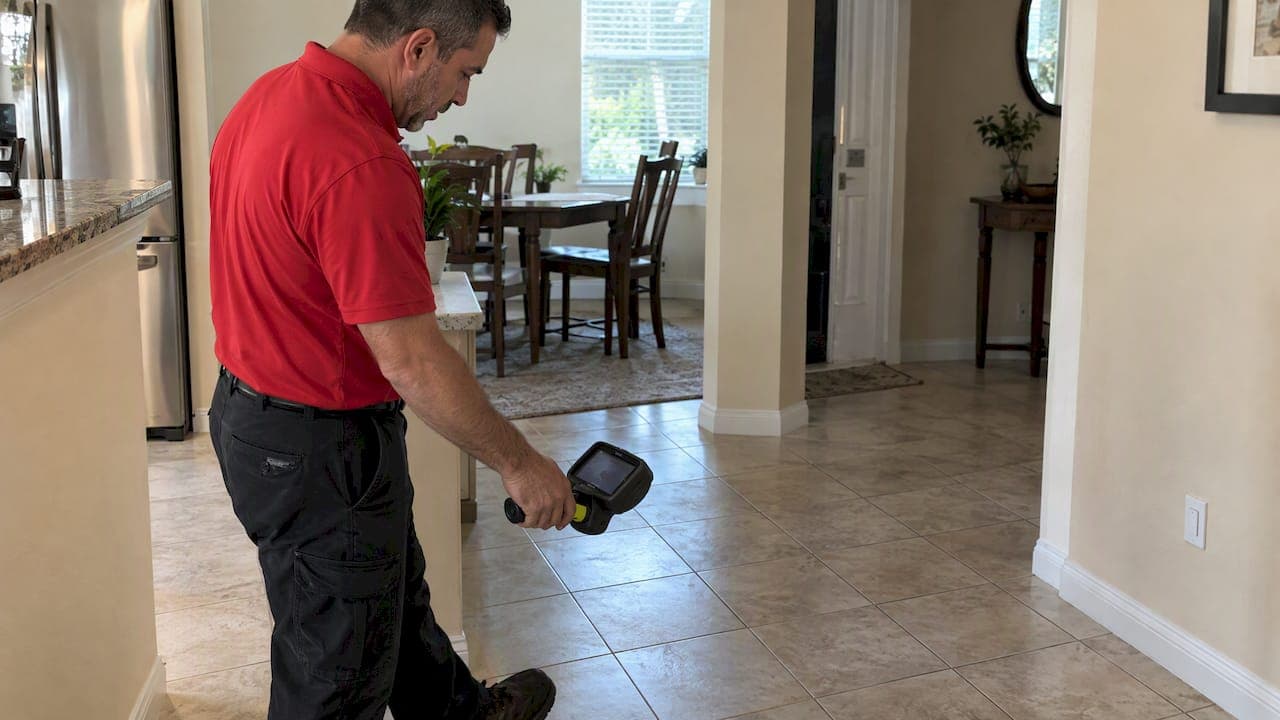
Professionals use a few methods to find the exact point of failure without opening the whole floor. Acoustic listening equipment picks up the sound of water escaping under pressure. Thermal imaging cameras can spot the warm or cool patch left by a leaking line. Tracer gas testing pushes a safe, detectable gas through the empty pipe and locates where it escapes through the slab. Camera inspection lets a technician run a small scope through accessible lines to look for cracks or blockages directly. Plumbing industry guidance consistently recommends this kind of precision locating before any demolition, since it limits the repair to the actual leak point instead of a guess.
Why early detection matters: mold, structural risk, and cost escalation
A slab leak that goes unnoticed for weeks or months does more than waste water. Moisture trapped under flooring and inside wall cavities creates the conditions mold needs to establish itself, and once it spreads past the surface layer, remediation becomes a bigger job than simply drying out a room.
The average household’s leaks waste more than 9,300 gallons of water per year, and fixing those leaks can cut a water bill by about 10%. A slab leak that runs continuously can push well past that household average in a fraction of the time, since it is often a steady flow rather than a slow drip.
Left alone, the moisture can undermine the soil beneath the slab, leading to settling or shifting that cracks the foundation itself. Floors, trim, cabinetry, and drywall near the affected area absorb water over time, which widens the scope of repair from a single pipe fix to a full reconstruction project.

Insurance adds another layer homeowners often misunderstand. Many policies cover sudden, accidental water damage but exclude damage attributed to wear and tear or gradual deterioration. Contact your insurer as soon as you suspect a leak, and keep photos, water bills, and meter readings as documentation, since the timing of discovery can affect how a claim is handled.
Immediate steps to take if you suspect a slab leak
Acting in the right order protects both your home and your ability to file an insurance claim later.
- Document what you are seeing. Take photos of damp spots, stains, or cracks, and save copies of recent water bills alongside your meter readings and the date you first noticed anything.
- Run the meter test and the toilet dye test described above to confirm water is actually leaving the system and to rule out the simplest causes.
- Limit water use while you investigate, but do not shut off your main water supply unless you are confident that is necessary. When in doubt, call a professional instead of guessing.
- Call a licensed leak locator or plumber to pinpoint the leak precisely. If you notice standing water, a musty smell, or visible mold, bring in a licensed restoration provider at the same time.
- Notify your insurer early and keep a record of every call, email, and receipt connected to the leak and its repair.
This order keeps you from making a small plumbing problem into a bigger demolition and mold remediation project, and it gives you a documented trail if you need to file a claim.
How a licensed restoration specialist handles slab leak damage
Once a leak is located and stopped, the damage it left behind, water, moisture, and sometimes mold, still needs to be addressed by someone licensed for the work. Our owner holds Florida licenses as a mold assessor and mold remediator, plus relevant industry certification, and has extensive experience as a home inspector prior to founding the company.
Our approach follows a strict sequence after a leak is found: nothing gets torn out of the house until the homeowner knows who is paying for it, whether that is an insurance claim or an out of pocket cost. We handle every call and visit directly rather than routing jobs through a dispatcher. Because we are licensed for both remediation and reconstruction, the same team that opens a wall for drying or mold removal is the one that closes it back up with drywall, flooring, or trim.
Homeowners dealing with a slab leak commonly need water extraction and drying, mold assessment and remediation, and reconstruction once the source is fixed.

Owner perspective: why locating first protects the homeowner
The biggest mistake we see is a technician reaching for a jackhammer before confirming exactly where the leak sits. A slab leak search should narrow down to a specific spot using acoustic, thermal, or gas trace equipment before anyone opens the floor, because every extra foot of concrete removed is time and money the homeowner did not need to spend.
When you schedule a visit, ask the technician directly how they plan to locate the leak and whether they will show you the result before any demolition starts. A straight answer to that question tells you a lot about how the rest of the job will go.
We lay out the likely cost and the insurance picture before anything comes out of the house, including the scenario where coverage does not apply, so you are deciding with full information rather than catching up after the fact.
— John Foutz
Get help after a slab leak: inspection, cleanup, and rebuild
Once a leak is stopped, the water and mold it left behind are our focus, and we handle that work the same way we handle locating: nothing comes out of the house until you know the cost and the insurance picture.

- Water damage restoration: extraction and drying for flooring, drywall, and trim affected by a slab leak.
- Free mold inspection: lab testing and air sampling if you notice a musty smell or visible growth.
- Reconstruction services: the same licensed team that removes damaged material also rebuilds it.
If you are in Central Florida and suspect a slab leak has caused water or mold damage, schedule a free inspection and talk directly with John about what comes next.
FAQ
Does homeowners insurance cover a slab leak?
Many policies cover sudden, accidental water damage from a slab leak, but most exclude damage caused by gradual wear and tear or long term settling. Coverage depends on your specific policy and how quickly the leak was discovered and reported, so contact your insurer as soon as you suspect a problem.
How long can a slab leak go undetected?
A slab leak can go undetected for weeks or months because the pipe sits under concrete and rarely produces a visible drip. Homeowners typically notice it first through a rising water bill, a warm floor spot, or a musty smell rather than through the leak itself.
Is a slab leak a big deal?
Yes, because an ongoing leak can waste a large amount of water, feed mold growth under flooring, and gradually undermine the soil beneath the foundation. The average household leak wastes over 9,300 gallons a year, and a continuous slab leak can exceed that quickly.
Is a slab leak an emergency?
A slab leak is not always a flooding emergency, but it should be treated as urgent since delay increases both water damage and mold risk. Run a meter test as soon as you suspect one and call a professional leak locator promptly rather than waiting to see if it gets worse.
Sources
- Fix a Leak Week | US EPA
- Meter test guidance | American Leak Detect
- Household leaks are costing you money — Lehigh County Authority