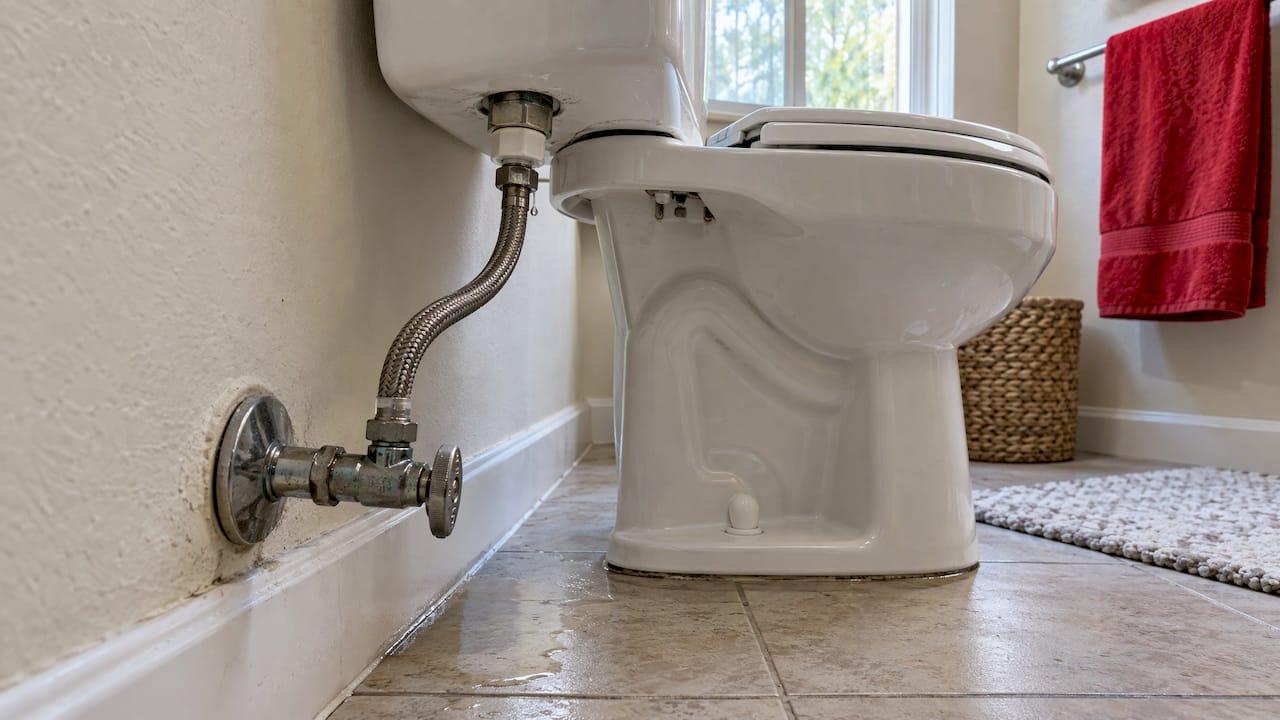
Toilet Supply Line Leak: Stop It, Fix It, Check for Hidden Water

If your toilet supply line is leaking or has burst, close the shutoff valve at the wall, flush to empty the tank, and find out whether the water came from the hose, a nut or the valve itself. Then replace the line. A supply hose is a cheap part. The floor, baseboard and drywall around it are not, and they decide whether this stays a $50 to $130 repair or becomes a restoration job.
I’m John Foutz, a licensed Florida mold assessor and remediator. Below is the repair routine, plus the part most plumbing guides skip: how to tell whether water got where you can’t see it.
TL;DR
- Turn the toilet’s shutoff valve clockwise, flush to empty the tank, and shut off the main supply if the valve spins freely or water keeps spraying.
- Dry everything, then check each joint with a tissue to see whether the hose, the nut or the valve is leaking.
- Never patch a damaged flexible line. Replace it, hand-tight plus a gentle quarter-turn.
- A professional replacement typically runs $50 to $130, according to 2026 repair pricing. Wet flooring or drywall is a different, bigger problem.
- If water reached the subfloor, baseboard or a wall, drying has to start fast. Call us before anything is torn out.
Table of Contents
- First five minutes: stop the water
- Find where the leak is coming from
- Replacing the line yourself
- What a supply line repair costs
- Did water get where you can’t see it?
- Insurance, cash and who pays
- Preventing the next leak
- Our view on a leak that looks small
- When to call us
- FAQ
- Sources
First five minutes: stop the water
Speed matters more than neatness. A burst line can run for as long as it takes you to reach the valve.
- Close the toilet’s shutoff valve. It is the small valve on the wall or floor behind the toilet. Turn it clockwise to close. This Old House notes that toilet shutoffs sit near the floor behind the toilet and that clockwise shuts the water off.
- Flush once or twice. With the water off, the tank empties and the bowl stops refilling. This Old House’s toilet repair guide gives the same sequence: shut off, flush a couple of times, then sponge out what’s left in the tank if you’re replacing the line.
- If the valve fails, shut off the main. If the handle spins freely or water keeps spraying with the valve fully closed, the valve has failed inside. A plumber’s 2026 emergency guide says to go to the main house supply in that case. The main is usually near the front of the house, close to the water meter or where the line enters the home, per This Old House.
- Stop the spread. Move rugs and bath mats, and put towels down. Don’t use a regular vacuum on standing water.
Test your shutoff valves before you need them. One utility’s guidance recommends turning a fixture valve off periodically and confirming the flow stops. A valve that has sat open for ten years often will not close when it matters.
Find where the leak is coming from
“Supply line leak” is shorthand. The water can come from four places, and each has a different fix. Guessing is how people replace a hose and still have a wet floor. This is the same frustration behind the forum threads that rank for this search: a new line, still leaking.
Dry every part of the supply path with a towel. Turn the water back on and wrap a dry tissue around one joint at a time. A plumbing company’s diagnostic guide reads the results this way:
| Where the tissue gets wet | What it means | What to do |
|---|---|---|
| The small nut where the hose meets the valve or the tank | Supply line connection | Snug it slightly, or replace the line or washer |
| Around the valve handle or stem | Stem or packing nut on the valve | A small snug on the packing nut, or replace the valve |
| Behind the valve where it meets the wall pipe | Compression joint | Remake the joint; this is plumber territory |
| Corrosion or a pinhole in the valve body | Failed valve | Replace the valve |
For the connection at the bottom of the tank, American Standard’s support article lists three usual causes: a loose connection, a worn rubber or fiber washer, or corroded parts. Its guidance is to tighten with a wrench carefully, because overtightening can damage the nut or the tank. For a washer, shut off the water, disconnect the line, and replace the washer with the same type and size. For corrosion, clean the threads and wrap them with Teflon tape.
The plumbing expert on This Old House puts the method simply: dry everything, get a flashlight, and get down on your hands and knees to see where the water starts. A leak that shows at the tank bolts or the base of the bowl is not a supply line problem at all. For help reading a slow leak you can’t locate, this guide on water line leak detection signs walks through the tests.
Replacing the line yourself
A supply line swap is a small job. Plumbing Price Guide separates handyman work (flappers, fill valves, handles) from licensed plumber work, which it lists as supply line or shutoff valve work, wax ring and flange work, and anything that needs a permit. If the valve is stuck, corroded or leaking at the wall, call a licensed plumber.
If the valve works and only the hose is bad, the steps are straightforward:
- Shut off the valve, flush, and sponge out the tank. Put a small bucket or towel under the connections.
- Use two wrenches where you can: one to hold the valve, one to loosen the nut. Turning the valve itself can crack the pipe behind the wall.
- Remove the old line. Check the valve threads and the tank fitting for corrosion.
- Install a new braided stainless line. Hand-tighten both nuts first. Then add a gentle quarter-turn with a wrench. The plumber’s guide above warns that going harder crushes the internal washer, which is how a brand-new line ends up leaking.
- Open the valve slowly. Let air clear, flush, and run a dry tissue around both joints.
- Check again after 15 minutes, then after a few hours, then the next morning.
Two rules matter here. First, don’t patch a split, bulging or kinked flexible line with tape or sealant. The same plumber’s guide says flexible lines are single-use safety devices that must be replaced completely. Second, replace the line any time you replace the toilet, the valve or the fill valve. Reusing an old hose on new equipment saves a few dollars and risks the floor.
To test the shutoff, SharkBite’s guide says to turn the stop off and flush. If water keeps filling the tank, the valve has failed and the line isn’t the real problem.
What a supply line repair costs
Plumbing Price Guide’s 2026 pricing table is the figure to hold in your head:
- Braided steel supply line: $8 to $20 in parts, 15 to 30 minutes of labor, $50 to $130 total with a professional.
- Shutoff valve replacement: $15 to $30 in parts, $100 to $225 total.
These are national averages. Local rates in Central Florida vary, and prices change, so treat them as a range for judging a quote. The point is the gap between this cost and what a wet floor costs. If the line burst while you were at work or asleep, the repair is the easy part.
Did water get where you can’t see it?
A drip into a bucket is a nuisance. A line that sprayed or ran for hours or overnight is different. Water goes under the baseboard, into the drywall and into the subfloor, and a Florida bathroom does not dry out quickly on its own.
Check these before you call the job finished:
- The floor around and behind the toilet. Press on vinyl or laminate. Soft, bubbled or lifting flooring means water is under it.
- The baseboard and the wall behind the toilet. Look for staining, swelling, paint that bubbles, or a baseboard that has pulled away from the wall.
- The ceiling below, if the bathroom is on the second floor. A stain or sag there means water went through the floor.
- Smell. A musty odor in the days after a leak often means moisture is still trapped somewhere.
- Cabinets or vanity next to the toilet. Check the base panel and the back.
The Connecticut Department of Insurance’s water damage guidance treats supply line inspection as a routine job because failures here do real damage. Surface towels only get what you can see.
Our rule is to treat anything wet longer than a day or two as a drying job, not a cleanup job. Wet drywall and flooring left closed up are where mold starts. Our guide to the first 24 to 48 hours after a burst pipe lays out what to do while you wait. If the water was dirty, for example from an overflowing bowl and not a clean supply line, read what Category 3 water means and our toilet overflow cleanup steps first. A clean supply line is fresh water. An overflowing toilet is a different hazard.

If you find dark growth on the wall or baseboard days later, our DIY mold removal guide sets out what a homeowner can handle and where to stop.
Insurance, cash and who pays
Most people with a wet bathroom floor have one question before any other: will insurance pay? Policies differ. Some cover sudden, accidental water discharge and not long-term seepage. Some have deductibles that exceed a small repair. Read your policy’s water damage section, and call your agent before you rip anything out. If you do not know what your policy says, that is a normal place to be, and it is where we start.
Here is how we handle it:
- Nothing comes out of the house until everyone knows who is paying for it.
- If you want a cash price, we put it in writing before a claim is filed.
- We lay out every outcome, including the one where insurance pays nothing.
- Work starts only after you have decided.
- If you go through insurance, we run the claim from start to finish.
That sequence protects you from the worst case: walls open, a claim denied and a bill nobody explained. If you are uninsured or paying out of pocket, the same rules apply, and we take that work. Our water damage restoration cost guide explains what drives pricing so you can compare a number to a number.
Preventing the next leak
A supply line fails slowly, then all at once. Prevention is cheap.
- Inspect every six months. The Connecticut guidance recommends inspecting the supply line every six months, making sure the connection to the valve is secure, and operating the valve to confirm it shuts off, replacing it if needed (Connecticut Department of Insurance).
- Replace braided lines every 5 to 7 years, even if they look fine, and look for bulging or kinking each year. That interval comes from Plumbing Price Guide’s annual checklist and the Pershing diagnostic guide.
- Exercise the shutoff valve by closing and reopening it once a year. A seized valve is the real emergency.
- Know where your main shutoff is. Show everyone in the house.
- Use a seasonal routine. A plumbing maintenance checklist for homeowners is useful to run through each year, and the toilet line belongs on it.
The same habit applies to other appliances. Refrigerator lines, washing machine hoses and dishwasher lines fail the same way. See our guides on refrigerator water leaks and stopping a washing machine overflow.
Our view on a leak that looks small
I did home inspections in Florida for close to ten years before I started this company. A toilet supply line leak is one of the most common things I saw, and it is almost never the line that costs the money. It is the hours between the leak and the day somebody opens the wall.
My advice is simple. Fix the line the same day. Then look at the floor and the wall as if you did not trust them. If anything is soft, stained or smells, get it checked this week.
When you call us, you reach me. I come out myself. I am licensed in Florida as both a mold assessor and a mold remediator, and the company is licensed to rebuild what we open, so the same company that dries and cleans is the one that closes the wall. We do not start tearing out until you know who is paying and what every outcome looks like, including the one where insurance pays nothing.
A small leak should stay a small leak. If it didn’t, I would rather tell you that on day two than have you find it on day thirty.
John Foutz
When to call us
If the leak was brief and the floor is dry to the touch, your repair is done. If any of the following is true, have us look:
- Water ran for more than a short time, or you don’t know how long.
- The flooring is soft, lifting, or stained.
- The baseboard or drywall is swollen or discolored.
- A ceiling below the bathroom is stained.
- There is a musty smell that doesn’t go away.
We do water damage restoration, including extraction and structural drying, and we also handle mold work if it has already started. Our free mold inspection is where we start if you suspect growth. The water damage restoration page shows how we handle the job. If drywall, flooring, cabinets or trim have to come out, we rebuild them under the same claim, so you are not looking for a second contractor. We serve homes across Seminole, Orange, Volusia and Lake counties, including Lake Mary.
Call Ready 2 Inspect and you reach John.

If you would like the restoration step done by the owner and not a dispatcher, start at ready2inspect.com.
FAQ
Can I tape or seal a leaking toilet supply line?
No. Tape or sealant on a split, bulging or kinked flexible line is a temporary measure at best, and a plumber’s emergency guidance says to replace the whole line. The part costs a few dollars. If the leak is at a threaded connection, a washer swap or a gentle snug may be enough, but a damaged hose should be replaced.
Do I use plumber’s tape on a toilet supply line?
Only on corroded or worn threads where a metal fitting seals on threads. American Standard’s guidance for a corroded tank connection is to clean the threads and wrap them with 2 to 3 turns of Teflon tape. Rubber-washer connections seal on the washer, not the threads, so tape doesn’t fix those.
Why does my new supply line still leak?
The usual causes are a nut that is too loose or too tight (hand-tight plus a quarter-turn is the target), a pinched or missing washer, or a leak that is really at the shutoff valve stem or the wall joint. Dry everything and use the tissue test to find which joint is wet before you replace anything else.
How long can a wet floor stay wet before mold is a concern?
We tell homeowners to treat anything still wet after a day or two as a drying job. Wet drywall, baseboard and subfloor in a humid Florida house are where mold tends to start, so if you can’t get the area dry, have it assessed.
Sources
- Fixing a Leaky Toilet, This Old House
- Tips for Controlling Plumbing Emergencies, This Old House
- Know How to Shut Off Your Home’s Water, West Travis County PUA
- How to Shut Off Water When a Toilet Supply Line Breaks
- How Do I Fix a Leaking Shutoff/Supply Valve, Pershing Plumbing
- Leak at the supply line connection, American Standard
- How to Replace Water Supply Lines, SharkBite
- Toilet Repair Cost: 2026 Pricing by Problem Type, Plumbing Price Guide
- Water damage quick tips, Connecticut Department of Insurance
- Plumbing Maintenance Checklist 2026 for Homeowners
- Water Line Leak Detection: Signs, Tests and Next Steps