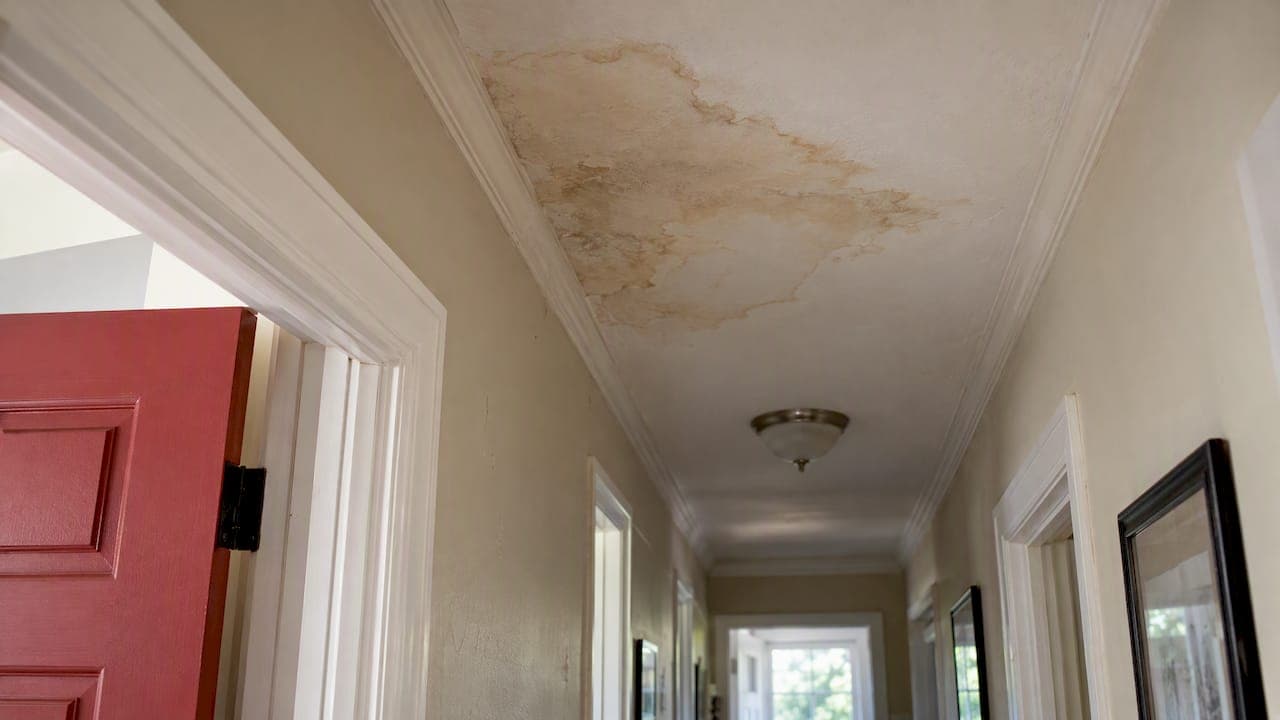
Ceiling Leak Stain: What It Means and What to Do First

A brown or yellow stain on the ceiling means water got into that spot at some point. The color does not tell you whether it is still getting in. Before you reach for primer, find out whether the stain is growing, where the water came from, and whether the drywall and insulation above it are still wet. Wet material is what turns a stain into a mold job.
I’m John Foutz. I’m a licensed Florida mold assessor and remediator, and I spent close to a decade as a Florida home inspector before starting Ready 2 Inspect. This guide is what I tell homeowners on the phone, in the order I tell it.
TL;DR
- A ceiling stain records that water was there. It does not prove the leak is active, and its color does not tell you the source.
- Growing or darkening rings, dampness, sagging, a musty smell, or changes after rain or water use point to a leak that is still going.
- Stay out from under sagging or bulging drywall, keep clear of light fixtures, photograph everything, and dry wet material within 24 to 48 hours.
- Stain-blocking primer hides a stain only after the leak is fixed and the material is dry. Painting over wet drywall gives mold a place to grow.
- In Central Florida, humidity makes a wet ceiling cavity a mold risk fast. We inspect mold for free and can lay out the cash price before any claim is filed.
Table of Contents
- What a brown or yellow ceiling stain actually means
- Is the leak still active?
- What to do in the first hour
- Can you just paint over it?
- Repairing the ceiling after the leak is fixed
- Our perspective: sequence matters more than speed
- How we handle a ceiling leak in Central Florida
- What to document if you may file an insurance claim
- FAQ
- Sources
What a brown or yellow ceiling stain actually means
A brown, irregular stain usually means water collected in the drywall from a leak above it. The usual suspects are the roof, a plumbing line, a water heater or other heating appliance, and the HVAC system. Condensation from poor insulation or ventilation can also stain a ceiling.
The yellow or brown tint comes from what the water picked up on the way down: dust, insulation fibers, rust, tannins from wood. Water that traveled a long way through an attic usually leaves a darker, dirtier ring than a fresh, clean supply-line drip.
That is why color is a poor diagnostic. A pale yellow ring can be an active pinhole leak. A dark brown one can be a roof leak that was fixed three years ago.
Where the water usually comes from in Florida homes
The source depends on what sits above the ceiling.
- Top-floor ceiling: Think roof first. Clues include recent rain, damaged shingles, failed flashing, defective vent seals and gutter problems. After a heavy afternoon storm, a stain that shows up or grows within a day or two is a strong hint.
- Ceiling under a bathroom, laundry or kitchen: Think supply lines, drains, tub overflow, a failed shower pan or a dishwasher hose. The stain often grows when someone uses the water.
- Ceiling near an air handler, return or duct run: Think a clogged condensate drain line, a rusted drain pan or sweating ducts. In a humid climate, an attic air handler that overflows can soak a ceiling in an afternoon.
- Ceiling with no plumbing or roof directly above: Water travels along framing and pipes, so the stain may sit several feet from the actual leak.
Not every mark is a leak either. InspectApedia describes thermal tracking, dust deposits from air leaks, register contamination and soot as look-alikes. A faint dirty line that follows a ceiling joist, with no ring and no soft spot, is often one of these. If it has a clear tide-line edge like a coffee ring, assume water.
Is the leak still active?
This is the question that decides everything else. Color cannot tell you. A growing or darkening ring, fresh dampness, a drip, a soft or sagging ceiling, a musty odor, or a pattern that changes after rain, showers, plumbing use or HVAC operation all suggest ongoing moisture. A dry, firm, unchanged stain is more likely old, but intermittent leaks are easy to miss.
A simple check you can do without opening anything:
- Trace the outer edge of the stain lightly in pencil and write the date next to it.
- Take a photo with a tape measure or coin in frame.
- Look again after the next rain, after a long shower, after the dishwasher or washer runs, and after the AC has run for a few hours.
- If the ring moved past your pencil line, the leak is active.
Press gently with a gloved hand only if the ceiling looks flat and firm. If it feels spongy, cool, or cold-damp, stop there.
Watch for hidden leaks, too. Small plumbing leaks inside wall and ceiling cavities can go unnoticed for some time, and porous insulation can take a long time to dry after a plumbing leak, and may never dry. A stain that looks small from below can sit on top of a much larger wet area.
What to do in the first hour
If the ceiling is sagging, bulging, cracked or dripping, treat it as a hazard.
- Keep people and pets out from under it. Do not puncture it, and stay clear of damage near electrical fixtures. A drywall ceiling holding water can come down all at once.
- Shut off the water if you know the source. A supply line, water heater or dishwasher can be isolated at its valve, or at the main.
- Turn off power to the area if water is near light fixtures or outlets. If you cannot do that safely at your panel, call an electrician.
- Photograph everything before anything is moved or cleaned. The EPA recommends photographing damage, checking for electrical and structural hazards, and drying wet materials as quickly as possible, ideally within 24 to 48 hours.
- Run fans and the AC to move air through the room, and keep indoor humidity in check. The EPA recommends keeping relative humidity below 60%, ideally 30 to 50%.
- Call someone to look at it if the ceiling is soft, the stain is growing, or you cannot find the source.
That 24 to 48 hour window matters more in Central Florida than in a dry state. Wet drywall in a warm, humid house does not have much time.
Can you just paint over it?
Only after three things are true: the leak is fixed, the material is dry, and the material is sound. Painting first hides the evidence and leaves the moisture behind it.
Primer technical sheets from the manufacturers say the same. Zinsser’s SmartPrime sheet says leaks must be repaired before priming, and that the stain may stay visible in the primer film while being locked in against bleeding through the topcoat. Its Covers Up ceiling product requires surfaces that are clean, dry, sound and free of mildew and loose coatings. An oil-base stain blocker from the same maker seals water stains and accepts oil or latex topcoats.
The right order for a cosmetic fix
- Fix the source and confirm it with at least one rain or a few days of normal water use.
- Let the ceiling dry fully. Do not rush this with a heat gun.
- Check for softness, mildew, or damaged texture. If you find any, cut that section out rather than coating it.
- Clean the surface and let it dry.
- Apply a stain-blocking primer over the whole stain, a little past its edge.
- Apply ceiling paint to the whole ceiling plane, or you will see the patch in raking light.
What about a magic eraser or bleach?
A melamine sponge might lighten a surface smudge, but it cannot reach water that soaked into the drywall paper. It also tends to scuff flat ceiling paint. Bleach on a stain does not dry out the drywall or fix a leak. If a stain returns through the paint, the cause is moisture that is still present or a primer that was skipped. Treat it as a moisture problem first.
What about yellow liquid actually dripping?
If liquid is dripping, not just staining, the water has already collected above the ceiling and carried dirt, insulation and rust with it. That is why it looks yellow or brown. Put a bucket under it, keep people out of the way, shut off the water if you can, and have the source found today. Do not poke a hole to drain a bulge unless you have a bucket under it, no electrical nearby, and you are prepared for the ceiling to open further. If you cannot tell what is above the ceiling, a licensed professional should do it.

Repairing the ceiling after the leak is fixed
The repair depends on how wet the drywall got and with what.
The U.S. Department of Energy’s repair guide says to remove damaged materials and let the structure dry. Keep ceiling drywall only if it was wet by clean rainwater and is not sagging, mildewed or texture-damaged, and remove wet insulation. Small damaged areas can be handled with a drywall repair kit, while large sections should be replaced and supported with framing.
Two cases come up often in Florida:
- Rainwater, caught early, firm drywall: Dry it, prime it, paint it. This is the one case where a cosmetic fix can be enough.
- Plumbing, AC drain or long-standing leak: That water is not clean, and it has usually been there longer. Cut the section out and replace the insulation above it.
Mold can grow behind drywall or above ceiling tiles, and porous materials such as ceiling tile can be difficult to fully clean and may need removal. If you open a ceiling and find dark growth, the job changes. The same applies to mold found during a remodel: stop, deal with the moisture and the growth, and then rebuild.
When mold shows up
The EPA’s central message is moisture control: find and fix the water source, dry the area quickly, then clean and remove mold. If you decide to clean a small area yourself, the EPA recommends gloves, goggles and at least an N95 respirator, and says children and people with asthma or weakened immune systems should stay away.
Call a licensed professional when any of these is true:
- The growth is spreading past a small patch.
- The ceiling was wet from plumbing, an AC line or sewage.
- The drywall is soft, sagging or crumbling.
- You smell mold but cannot see where it is.
- Someone in the house has asthma or a weakened immune system. For questions about symptoms, see a doctor. Our mold exposure symptoms page explains what we can and cannot say about health.
Our perspective: sequence matters more than speed
Most people who call us about a ceiling stain are not worried about the stain. They are worried about what it will cost and whether insurance will pay. That worry is reasonable, and it is why we work in a set order.
Nothing comes out of your house until you know who is paying for it. We tell you the cash price up front, before a claim is filed. We lay out every outcome, including the one where insurance pays nothing. Work starts only after you have decided.
There are a few things I have learned from years of looking into ceilings:
- The stain is rarely the full story. The wet area above it is usually bigger.
- The AC system is the thing that turns one wet ceiling into a whole-house problem in Florida, because it moves humid air and spores through the house.
- A cosmetic fix on a wet ceiling is the most expensive way to save money.
- If you want to handle a small, dry, clean patch yourself, that is fine. I will give you the instructions in detail, and I will tell you where the stopping point is.
Because we are licensed for both the mold work and the reconstruction, the company that opens the ceiling is the one that closes it. You deal with me, not a dispatcher.
— John Foutz
How we handle a ceiling leak in Central Florida
We serve homeowners across Seminole, Orange, Volusia and Lake counties from our base in Lake Mary. A typical ceiling call goes like this:
- We look first. Our free mold inspection covers visible growth and moisture in the affected area. Laboratory testing and air sampling are available when they will answer a real question.
- We stop the damage from spreading. If the leak is recent, our water damage restoration work covers extraction and structural drying so the wet cavity does not become a mold job.
- If mold is present, licensed mold remediation removes it under containment.
- We rebuild. Drywall, trim, flooring, tile, cabinets and counters are all done by us under the same license, so there is no handoff.
- We run the claim. If you are filing with insurance, we manage it. If you are paying cash, you get the price in writing before anyone touches the house.
If your ceiling is stained and you want someone licensed to look at it this week, call us or start from our Lake Mary page.

We also serve Orlando, Winter Park, Longwood, Winter Springs and other nearby cities. See our services and fees for how we price work.
What to document if you may file an insurance claim
Homeowner policies differ, and what they cover after a leak depends on the cause and your policy language. Read yours or ask your agent before assuming anything. What helps in nearly every case:
- Dated photos and video of the stain, the room and anything damaged, taken before cleanup.
- The date you first noticed it and any recent rain, plumbing work or appliance failures.
- Receipts for any emergency steps, such as a plumber, tarp or fans.
- A written scope from whoever inspects it.
Do not tear out wet material before photographing it. Do not agree to a full repair before you know who is paying. We can explain your options before you commit to anything.
FAQ
Why is my ceiling leaking yellow liquid?
The water has collected above the ceiling and picked up dust, insulation fibers and rust before coming through. Yellow or brown liquid often means the water has been there a while, but it can be fresh too. Keep people away, put a bucket under it and have the source found quickly, since it can come from the roof, plumbing or the AC.
Will a magic eraser remove a water stain from a ceiling?
It may lighten a surface mark but will not remove a stain that has soaked into drywall paper, and it can scuff the paint. The lasting fix is repairing the leak, drying the ceiling, and sealing with a stain-blocking primer before repainting. If the drywall is soft or mildewed, replace it instead.
How do I fix a water stain on a ceiling?
Fix the leak first, then dry the ceiling and check that the drywall is firm. Clean the area, apply a stain-blocking primer, and repaint the whole ceiling. Cut out and replace any drywall that is sagging, soft or mildewed.
Does a brown ceiling stain mean there is mold?
Not necessarily. A stain means water, and mold needs moisture and time. If the stain is old and dry, there may be none. If the ceiling is damp, smells musty or the stain is spreading, have it inspected.
Sources
- Water Stains on the Ceiling: Common Causes and Solutions
- Ceiling Stains & Thermal Tracking, InspectApedia
- Ceiling Water Stain: Is the Leak Active or Old?
- Moisture Control Guidance for Building Design, Construction and Maintenance, EPA
- Homeowner’s and Renter’s Guide to Mold Cleanup After Disasters, EPA
- Tribal IAQ Resource Directory: Mold and Moisture, EPA
- Mold: Worker and Employer Guide to Hazards and Recommended Controls, EPA
- Repairing Roofs and Ceilings, U.S. Department of Energy
- Zinsser SmartPrime technical data sheet
- Zinsser Covers Up Ceiling Paint & Primer technical data sheet
- Zinsser Odorless Oil Base Stain Blocker technical data sheet