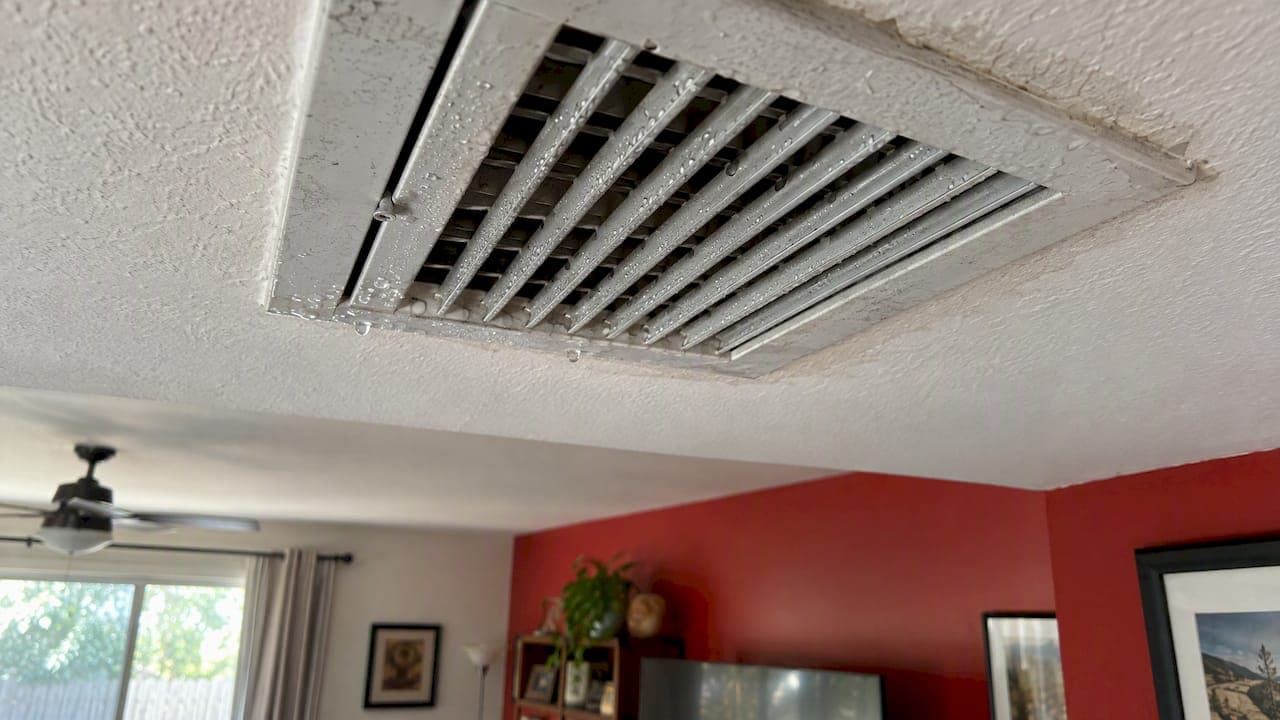
Condensation on AC Vents: Causes, Fixes and When It’s Mold

Water beading on an AC vent means warm, humid air is touching a surface colder than its dew point. In Central Florida that happens easily. The fix depends on which side of the problem you have: the air is too humid, or the vent and duct behind it are too cold. A little sweat now and then is normal. Drips, stains, a musty smell or dark spots around the register are not, and they need attention before the ceiling does.
I’m John Foutz. I’m a Florida-licensed mold assessor and remediator, and before starting Ready 2 Inspect I spent close to a decade as a Florida home inspector. Sweating vents are one of the most common things I find above a ceiling that later turns into a mold job. Here is how to work out what is going on, what you can safely do yourself, and where the line is.
TL;DR
- Vents sweat when humid air meets a cold surface. The cause is always the same, but the reason differs: too much moisture in the air, or a vent that is too cold.
- Start with the easy checks: replace the filter, open all vents, and look at the condensate drain line.
- Water that shows up only while the AC runs, and not after rain, points to the AC. Water that shows up during or after rain points to the roof. You can have both.
- Stains, puddles, a musty smell or dark growth mean it has gone past maintenance. Stop guessing and have the cavity checked.
- We offer a free mold inspection in Seminole, Orange, Volusia and Lake counties.
Table of Contents
- Why AC vents sweat
- The most common causes in Central Florida homes
- Condensation, roof leak or plumbing: how to tell
- What to do today
- When condensation turns into a mold problem
- A look from our side of the ceiling
- What a professional inspection looks at
- Preventing sweating vents in a Florida house
- If you have wet drywall or mold around a vent
- FAQ
- Sources
Why AC vents sweat
A glass of iced tea sweats on a July porch for the same reason a vent does. Building scientist Allison Bailes explains that the cause is always humid air meeting a cold surface, and the reasons split into two groups: the air is too humid, or the vent is too cold.
That split matters because the fixes are different. If you lower the humidity when the real problem is a bare, uninsulated duct, you will keep wiping the register. If you wrap the duct when the house is running at high humidity from outdoor air leaking in, you will move the sweating somewhere else.
The EPA’s moisture control guidance puts a number on it. To prevent condensation on indoor surfaces while cooling, keep the indoor dew point below 55°F. That corresponds roughly to 50% relative humidity at an indoor air temperature of 75°F. Watching only the humidity percentage, without thinking about the temperature of the air and surfaces, is a common reason people never get ahead of the problem.
In our climate the outdoor air is often well above that dew point for months. Anything that lets that air into the house or into the ductwork will set off condensation the moment it meets cold metal.

The most common causes in Central Florida homes
Missing or damaged duct insulation
Supply ducts that run through a hot attic carry very cold air. If the insulation wrap is torn, crushed, or pulled back from the boot (the metal or plastic collar that connects the duct to the ceiling register), the cold surface sits in hot, humid attic air. The water collects on the outside of the duct and the register, then soaks into the ceiling drywall around it.
The giveaway: sweating mostly at one or two vents, often the ones at the end of a long run, and the drywall around the register gets a ring-shaped stain.
Leaky ducts pulling in attic air
When the system runs, leaks in supply ducts can pull hot, humid attic air into the cold airflow and cause condensation inside the duct. When the system is off, humid air can also drift into a leaky duct and condense on the cold metal. Either way, you see water at the vent but the fault is in the duct.
Too much humidity inside the house
Cooking, showers, a dryer that vents poorly, and an AC that is oversized and cools the house so fast it shuts off before removing much moisture all push humidity up. A thermostat set very low makes the vent surfaces colder, which makes it worse. Cooler is not always drier.
Air leaking into the house
This one gets overlooked. The EPA describes how a home with negative pressure draws unconditioned outdoor air in through gaps, cracks and holes. That air is not dried by your AC, and it condenses on whatever the AC has made cold. You can have a working system and still have sweating vents because the envelope leaks.
Dirty filter, closed vents and low airflow
A clogged filter or closed registers cut airflow across the coil. The coil gets colder than it should, and in bad cases it ices up and then melts into the drain pan faster than the drain can handle. Restricted airflow also makes the duct surfaces colder. Service Champions recommends wide-open vents and a fresh filter at least monthly as the first step.
A clogged condensate drain line
Your AC removes gallons of water from the air each day in summer. That water leaves through a drain line. When algae and slime plug it, the pan fills and overflows. If the air handler is in the attic, the overflow soaks the ceiling below and can look exactly like a sweating vent or a roof leak. The same source notes that drain pans typically last 5 to 10 years before rusting and failing.
Condensation, roof leak or plumbing: how to tell
This is the question that matters most when you see a wet ceiling. A few clues sort the three apart.
| Clue | AC condensation | Roof leak | Plumbing leak |
|---|---|---|---|
| When it shows up | Only while the AC runs, or in humid weather | During or after rain | Constant, or when a fixture or appliance runs |
| Where | At the vent, duct, or below the air handler | Under the roof line, often away from vents | Under a bathroom, kitchen, laundry or water heater |
| Dry weather | Still appears | Usually stops | Still appears |
| What the water looks like | Clear to slightly rusty | Brown stain with a ring | Can be clear, or stained if it has been slow |
The Coastline Roofs guide to ceiling stains makes the Florida point well: if the stain is near the attic air handler, appears in the cooling months and has nothing to do with rain, a clogged condensate drain is the likeliest culprit.
Two cautions from experience:
- The stain is rarely under the source. Water travels along rafters, decking and the top of the drywall before it finds a low point, so the drip can be several feet from where it started. A stain under a vent does not prove the vent is the cause.
- It can be more than one thing. A small roof flaw and a humidity problem can exist at the same time. If you fix only the visible leak, the humidity keeps feeding mold. A proper inspection looks for both.
A quick test: run the AC for an hour with no rain, and check the ceiling and vents. Then check again after the next storm with the AC off. Write down what you see and when. That log helps whoever comes out, whether it is a roofer, plumber or HVAC technician.
What to do today
These steps are safe for most homeowners and cost little.
- Replace the air filter and keep checking it monthly during cooling season.
- Open every supply vent. Closing rooms to save energy can chill the ducts and reduce airflow.
- Raise the thermostat a couple of degrees if it is set very low. Do not turn the system off in a humid house, since that lets humidity climb.
- Check the condensate drain. Find the PVC line near the indoor unit and look for standing water in the pan. For a minor clog, a vinegar and water solution is a common treatment. A serious blockage needs a licensed HVAC technician.
- Wipe the vent dry and look at the ceiling around it with a flashlight. Press gently on any stain. Soft or crumbly drywall means the moisture has been there a while.
- Dry what you can reach. Put a towel or pan under a dripping register and run a fan across a wet ceiling area.
Do not rely on a room humidity gauge alone. The EPA notes that readings taken in the room say little about conditions at cold surfaces or inside wall cavities. A room can feel fine while the ceiling around a vent is staying wet.
Who to call for what
- HVAC technician: drain line clogs, a failed drain pan, a coil that is icing, oversized equipment, leaky or poorly insulated ducts.
- Roofer: a stain that tracks with rain.
- Plumber: a leak that does not depend on weather or the AC.
- Mold and water restoration company: wet or stained drywall, insulation or carpet, a musty smell, or visible growth. That is where we come in.
If you are not sure which one you need, call us. Honestly, we would rather tell you it is a drain line and send you to an HVAC tech than sell you work you do not need.
When condensation turns into a mold problem
Water on a vent is not mold. Wet drywall, insulation or carpet that stays damp is where mold can start. The EPA’s guidance warns that persistent condensation can let mold take hold on porous materials such as gypsum board, carpet and insulation. Mold needs moisture, and a ceiling that gets wet every time the AC runs provides it day after day.
Signs that it has gone past maintenance:
- A musty smell near the vent or in the room below that does not fade after you dry the area
- Dark, fuzzy or speckled spots on the register, the drywall around it, or the duct boot
- A stain that keeps growing or comes back after you paint it
- Sagging, soft or bubbled ceiling drywall
- Puddles on the floor or insulation that feels wet or looks matted
- Damp spots that show up on the other side of the room from the AC
Do not paint over a stain or spray the vent with a household product and call it done. If there is mold in the cavity, a coating just hides it, and the moisture is still there. If you are wondering about symptoms in the household, our page on mold exposure symptoms and warning signs explains what is and is not known. We do not diagnose anyone. Talk to your doctor about health concerns.
Why the AC makes it worse
When the same system that is creating the moisture also moves air through the house, a small problem at one register can spread. Mold or damp conditions in an air handler, duct or drain line can send odor and spores through the system. That is why we treat the HVAC as part of the inspection rather than an afterthought.
A look from our side of the ceiling
Here is how we think about this, and why we handle it the way we do.
Most people call because they see a stain and assume the worst. Others wait because they assume it is “just condensation.” Neither reaction is a plan. The first question I ask is what the water is doing and when. If it follows the AC schedule, I look at the drain line, the insulation and the airflow. If it follows the rain, I look at the roof. Then I look at the cavity above the ceiling, because that is where you find out if the moisture has been feeding something.
The next thing I do is lay the options out before anything comes apart. If the drywall around a vent is wet and there is no growth, drying and fixing the cause may be all you need. If there is growth, it is a remediation job with a defined area. If a claim might be involved, everyone should know who is paying for what before a single piece of drywall comes out. I will tell you the cash price up front, I will tell you what happens if insurance pays nothing, and the work starts when you have decided.

Because we are licensed for the reconstruction as well as the mold and water work, the same company that opens the ceiling is the one that closes it, with drywall, texture and trim. You deal with me directly. I answer the phone and I come out myself.
One more thing: fixing the ceiling without fixing the cause is the most expensive repair there is. Whatever you do, make sure someone has found why the surface was wet.
— John Foutz
What a professional inspection looks at
When we come out for a sweating vent that has left a stain or smell, we work through the same sequence:
- History. When did you first see it? Does it follow the AC, rain or a fixture?
- Moisture readings. A meter and a thermal camera show how far the wet area goes beyond what you can see.
- The cavity. We look above the ceiling at the duct, boot, insulation and any growth.
- Possible sources. Drain line, pan, ducts, attic air leaks, roof and plumbing.
- Air or surface sampling, only when it will answer a real question. Lab testing and air sampling are part of what we offer.
- Options in writing. What it costs if you pay directly, what might go through a claim, and what happens if it is denied.
The initial mold inspection is free. If the problem is outside our scope, such as a failed drain pan or torn duct wrap, we will say so and tell you which trade to call.
Preventing sweating vents in a Florida house
No single fix works everywhere, but these habits cut the risk:
- Change the filter on a schedule, and write the date on it.
- Have the drain line flushed and the pan checked as part of regular AC service, especially if the pan is old.
- Have the supply ducts and boots inspected for torn insulation and leaks, particularly in the attic.
- Seal gaps where outdoor air gets in: attic hatches, can lights, around plumbing and wiring penetrations.
- Use bath and kitchen exhaust fans, and make sure they vent outside, not into the attic.
- Keep the thermostat at a sensible setting and avoid big swings.
- If humidity stays high despite all of this, ask an HVAC contractor about right-sizing or whole-house dehumidification. Trane’s overview of HVAC condensation is a plain-language place to see how the system produces and removes moisture.
If you want a second opinion on how your house handles moisture, Energy Vanguard’s explanation of why vents sweat walks through the same cause and the multiple reasons behind it.
If you have wet drywall or mold around a vent
We handle mold remediation and water damage restoration across Seminole, Orange, Volusia and Lake counties, and we can also take care of the rebuild and the insurance paperwork. If you are in Lake Mary, here is our local service page, and for Longwood homeowners, see Longwood.
Want someone to look this week? Request your free inspection. You will talk to me, not a call center, and you will know the options and the price before any work starts.
FAQ
Is it normal for an AC vent to drip water?
A few beads of moisture on a cold register during a humid spell can be normal. Steady dripping is not. It means humid air is reaching a cold surface in quantity, usually from damaged duct insulation, duct leaks, high indoor humidity or a drain problem. Check the filter and the drain line, and have the duct and ceiling checked if it keeps happening.
Does condensation mean my house is too cold?
Not exactly. Condensation is about the dew point, not just the thermostat setting. The EPA’s guidance is to keep the indoor dew point below 55°F during cooling. Setting the thermostat lower can chill surfaces further, so it can make sweating worse if the air is still humid.
How do I tell a roof leak from condensation?
Timing is the best clue. A roof leak follows rain and tends to stop in dry weather. Condensation follows the AC cycle and humid weather, and usually appears at a vent, duct or the air handler. Both can happen together, so a good inspection checks the roof, the drain line and the ducts before anyone repairs only one.
Can I just spray the vent or duct with a cleaner?
Spraying will not fix the cause, and it does nothing about wet drywall or insulation above the ceiling. If you see dark growth on or around the vent, do not disturb it. Have it assessed first, so you know how far it goes and what is feeding it.
When should I call about a sweating vent?
Call when you see a stain, soft drywall, a musty smell, dark spots or puddles. Those are signs the moisture has gone past the vent. A free inspection tells you whether it is a drying job, a mold job, or a call for your HVAC tech.
Sources
- Moisture Control Guidance for Building Design, Construction and Maintenance (EPA)
- Indoor air quality guidance (EPA)
- Why Air Conditioning Vents Sweat (GreenBuildingAdvisor)
- Why Do Air Conditioning Vents Sweat? (Energy Vanguard)
- Causes of Condensation on AC Vents and How to Fix It (Service Champions)
- Brown Water Stain on Your Ceiling: Roof or Plumbing? (Coastline Roofs)
- HVAC Condensation: Causes and Solutions (Trane)